The Practical Keyword Research Guide We Hand to New Clients
Most keyword research ends as a spreadsheet of 4,000 terms sorted by volume. Ours ends as a short list of pages to build or fix, each with a clear reason to exist. This is the process we walk every new client through.

Key takeaways
- Start keyword research with customer language from sales calls, reviews and Search Console, not with a tool’s seed list.
- Classify every keyword by intent before looking at volume. The wrong intent makes the right volume worthless.
- Read the actual search results. The page types Google ranks tell you what you must build to compete.
- Weigh business value against difficulty, then cluster related terms so one strong page targets a whole group.
- Map every cluster to exactly one URL. Two pages chasing the same cluster usually means neither ranks well.
01Why most keyword research never turns into traffic
Almost every new client arrives with a keyword list. Sometimes it came from a previous agency, sometimes from a free tool, once from a founder’s nephew. The lists are rarely wrong, exactly. They are just unfinished. Keyword research is not the act of finding terms people search for. It is the act of deciding which searches your business should win, which page will win each one and in what order you will build those pages.
The gap shows up the same way every time. A SaaS client had a list of 1,200 keywords sorted by monthly volume. The top 50 were broad, informational terms dominated by encyclopaedias and huge software review sites. Meanwhile the searches their sales team heard on every demo call (specific integrations, comparisons with a named competitor, pricing questions) were nowhere on the list, because tools showed them with low or no volume. Those were the terms that turned into pipeline within a few months once pages existed for them.
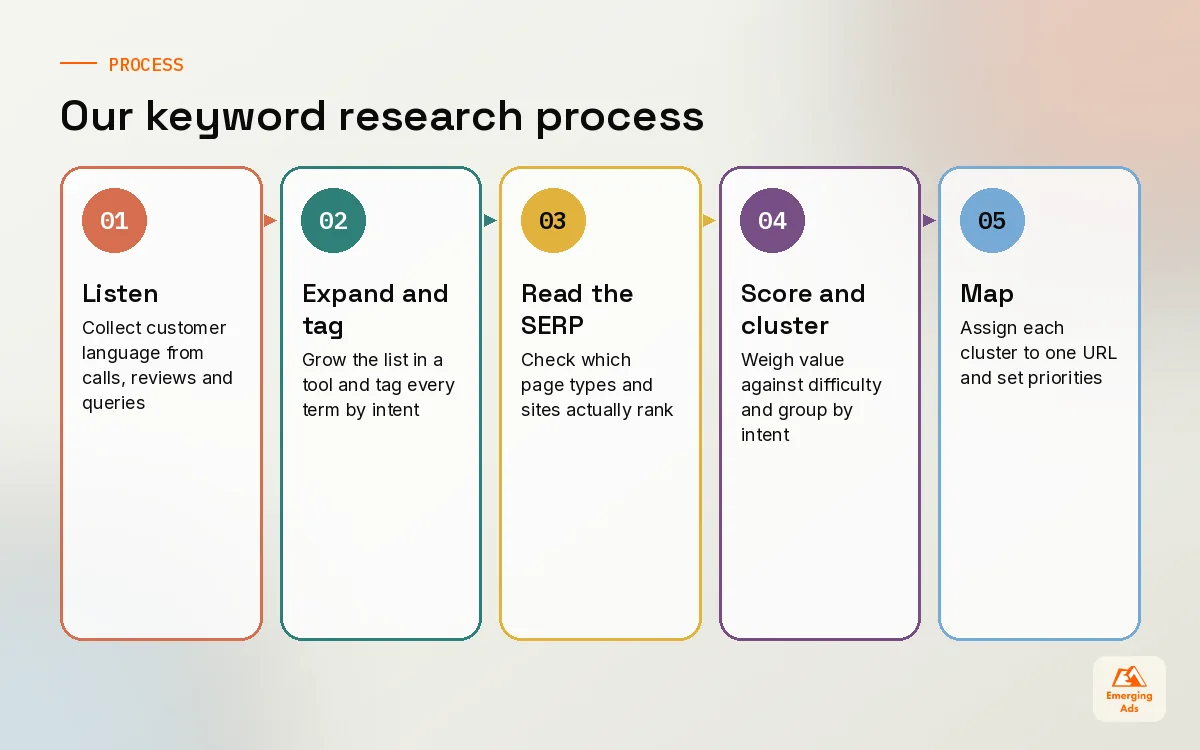
Our keyword research services follow the six stages below. You can run the same process yourself with a spreadsheet, Search Console and one paid tool.
02Step 1: Start with customer language, not a tool
Tools are brilliant at expanding a seed term into hundreds of variations. They are terrible at telling you which seed terms to start from. That part comes from people. Before we open any tool, we collect the words customers actually use, and they are almost never the words on the client’s homepage.
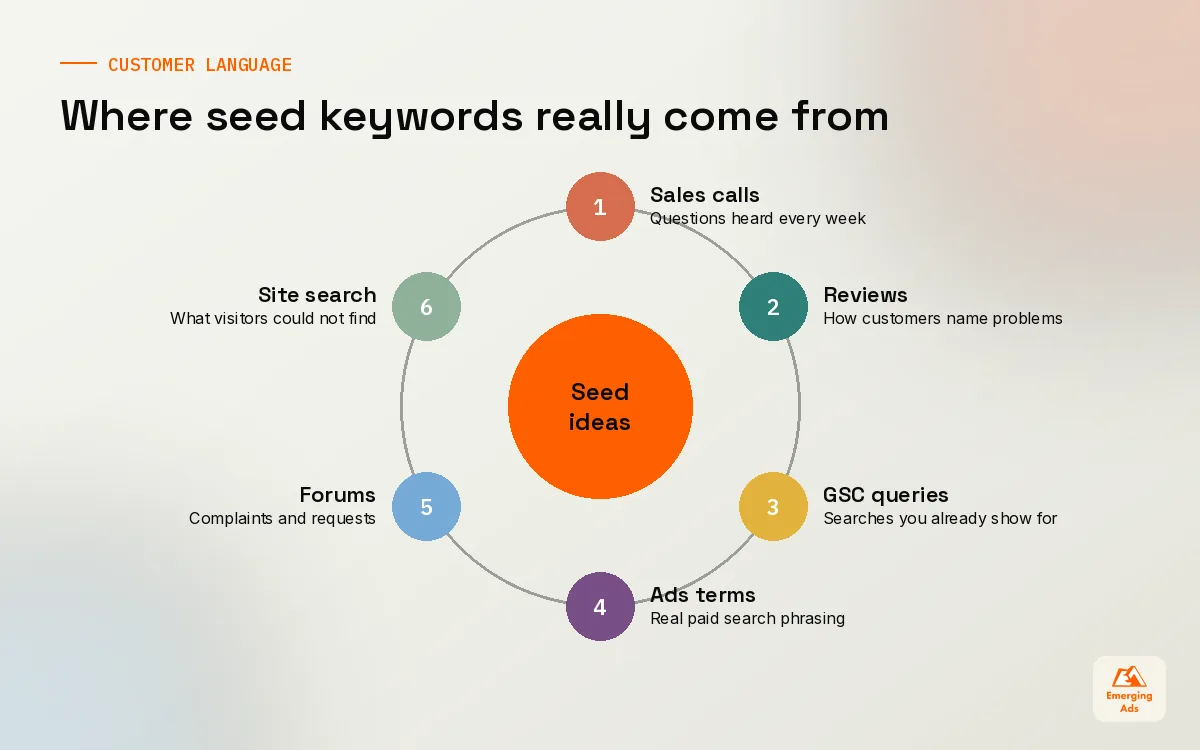
Where we find the real words
- Sales and support calls. Ask the team for the ten questions they hear most. Record them verbatim.
- Reviews of your business and your competitors. Customers describe the problem, not the product.
- Search Console queries you already get impressions for, especially the ones with no dedicated page.
- Paid search term reports. If you run Google Ads, the search terms report is a gold mine of real buyer phrasing.
- Forums, Reddit threads and community groups where your audience complains or asks for recommendations.
- Internal site search logs, which show what visitors expected to find and did not.
A dental clinic we work with called their core service “restorative dentistry”. Patients searched for “broken tooth repair”, “crown same day” and “tooth fell out what to do”. The clinical term was accurate. It was also almost invisible in search. If you already run Google search ads, exporting twelve months of search terms before you start is the quickest win in this whole guide.
03Step 2: Expand and sort by search intent
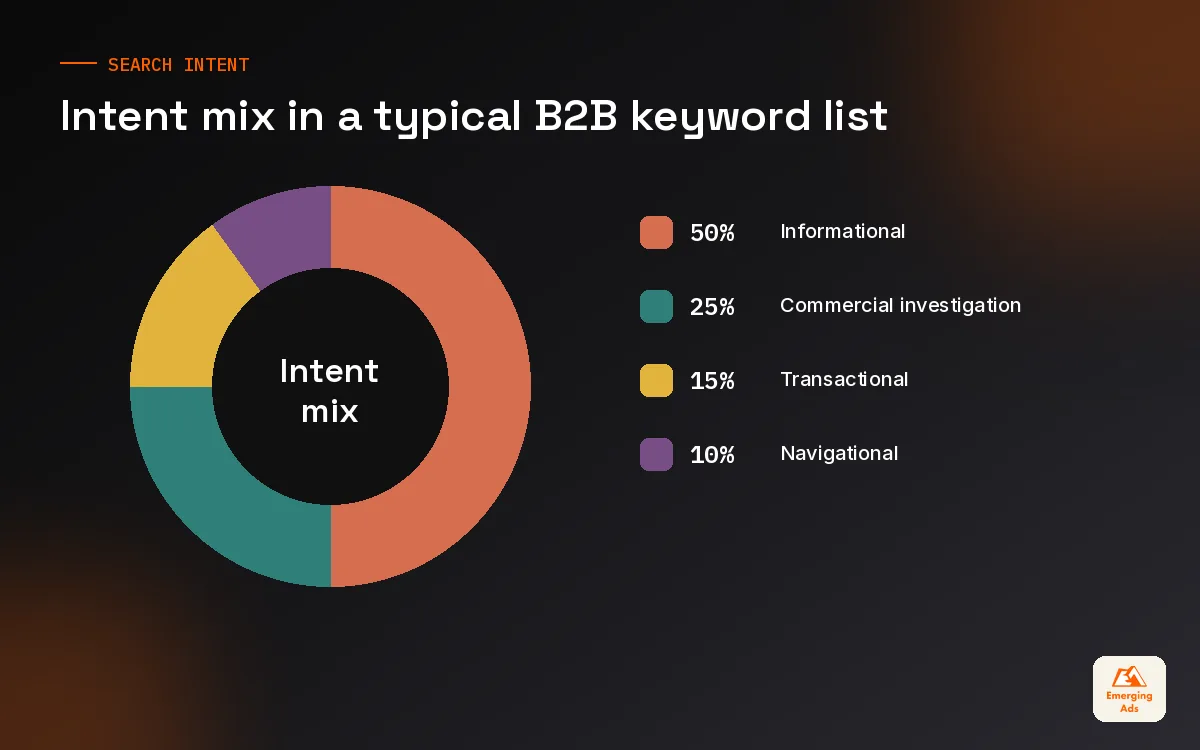
With a few dozen seed phrases, now use a tool to expand them. We work mostly in Semrush and Ahrefs, and both do the job well. Pull matching terms, questions and related keywords for each seed. Then, before you look at volume, tag every keyword with an intent.
| Intent | What the searcher wants | Example phrasing | Page that usually fits |
|---|---|---|---|
| Informational | To learn or solve a problem | how to fix a leaking tap | Guide, blog post, video |
| Commercial investigation | To compare options before buying | best CRM for small agencies | Comparison, list, review page |
| Transactional | To buy or book now | emergency plumber near me | Service, product or category page |
| Navigational | To reach a specific brand or page | brand name login | Homepage or specific brand page |
Intent matters more than volume because it decides what kind of page can rank. You cannot rank a service page for a question Google answers with how-to guides, however well optimised it is. We see this constantly: a client trying to push a product category page for a “how to choose” query, when every result on page one is a buying guide.
Mixed and shifting intent
Some searches carry mixed intent, and the results show a blend of guides and product pages. For those, we look at which type holds the top three positions and build that first. Intent also shifts with seasons and news, so recheck your biggest targets every few months rather than assuming last year’s results still hold.
04Step 3: Read the results page before you commit
This is the step most keyword research skips, and it is the one that saves the most wasted content. For every keyword you are seriously considering, search it in a private window from the right country and study the first page. Tools estimate difficulty from backlinks. The results page tells you what you actually have to beat.
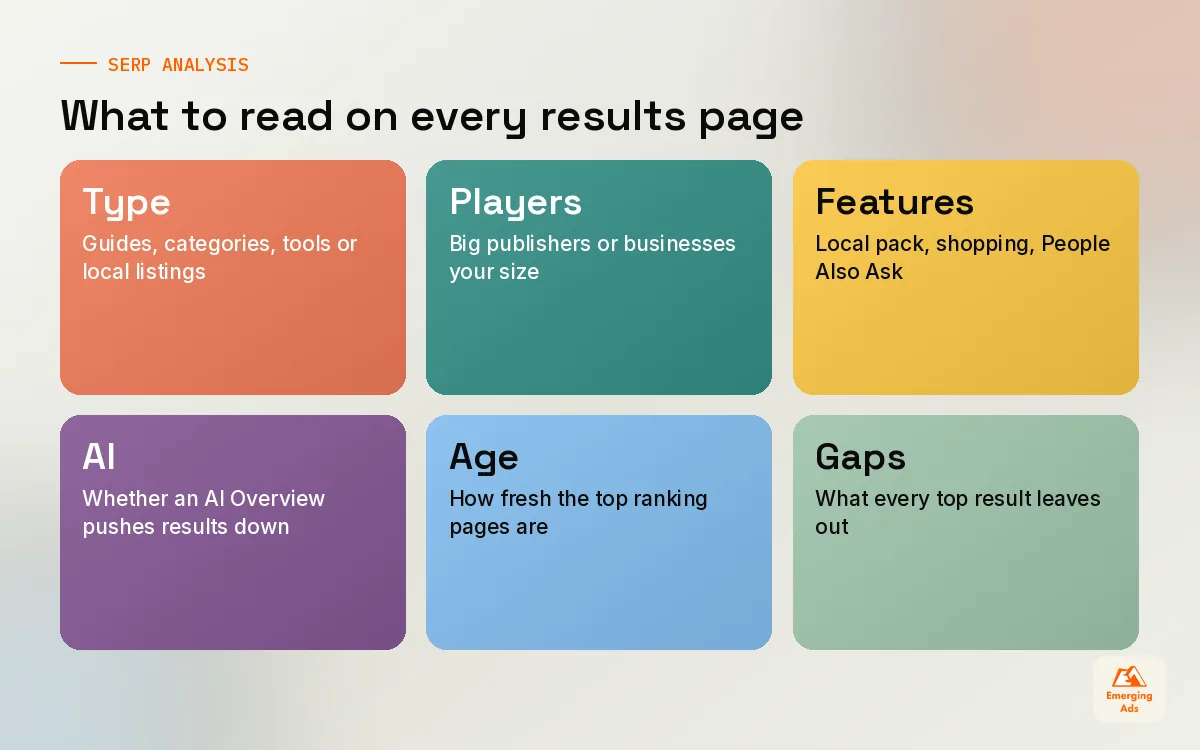
What we look for on every SERP
- Page types. Are the winners guides, category pages, tools, videos or local listings?
- Who ranks. Huge publishers and marketplaces, or businesses about your size?
- SERP features. A local pack, shopping results, People Also Ask boxes or an AI Overview pushing organic results down.
- Freshness. Are the top pages recent, or years old and ripe for a better version?
- Content depth. How thoroughly do the top results answer the question, and what do they all leave out?
A B2B client wanted to rank for a broad two-word software term. The first page was entirely large review platforms and the software vendors themselves. We moved them to narrower phrasing around their specific industry and use case, where the results were a mix of small vendors and thin listicles. That is a fight you can win.
The keyword tool tells you what people search. The results page tells you what Google believes they meant. Build for the second one.
05Step 4: Weigh business value against keyword difficulty
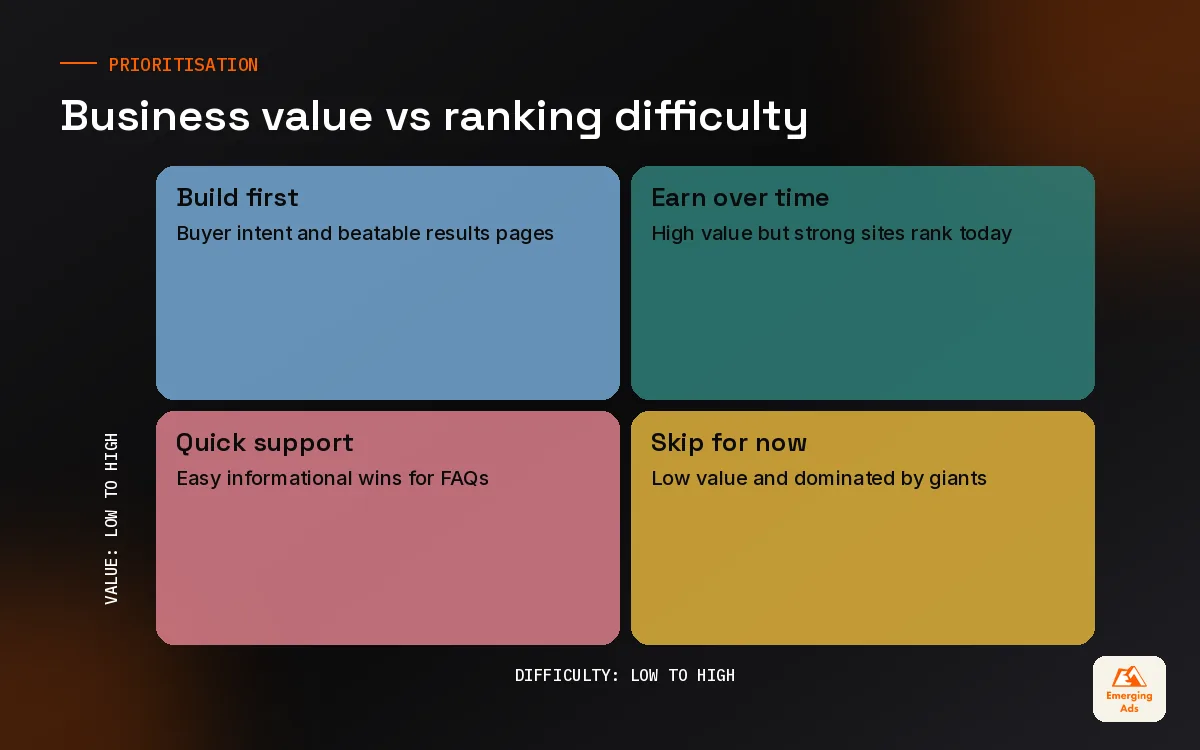
Now you have intent-tagged keywords with a sense of what ranks. The next job is choosing. We score each candidate on two axes: how valuable a visitor from that search would be to the business, and how hard it will be to rank. Volume matters, but it is a third consideration, not the first.
Scoring business value honestly
We use a simple 1 to 3 scale. A 3 means the searcher is close to buying something you sell. A 2 means they have the problem you solve but are still researching. A 1 means the topic is related but the reader is unlikely to become a customer soon. A search with modest volume and a value of 3 almost always beats a large-volume search with a value of 1.
| Keyword example | Intent | Value (1 to 3) | Difficulty read | Decision |
|---|---|---|---|---|
| accounting software for architects | Commercial | 3 | Moderate, small vendors rank | Build first |
| what is double entry bookkeeping | Informational | 1 | High, big publishers rank | Skip for now |
| [competitor] alternative | Commercial | 3 | Low to moderate | Build first |
| how to invoice a client | Informational | 2 | High | Cover later in a guide |
| accounting software pricing | Transactional | 3 | High, vendors dominate | Improve existing pricing page |
Values and decisions above are illustrative, from a planning session format we use, not real volumes. Treat difficulty scores in any tool as relative within that tool. A score of 30 in one does not equal 30 in another, and none of them know your site’s topical strength as well as your own Search Console data does.
06Step 5: Cluster keywords into topics
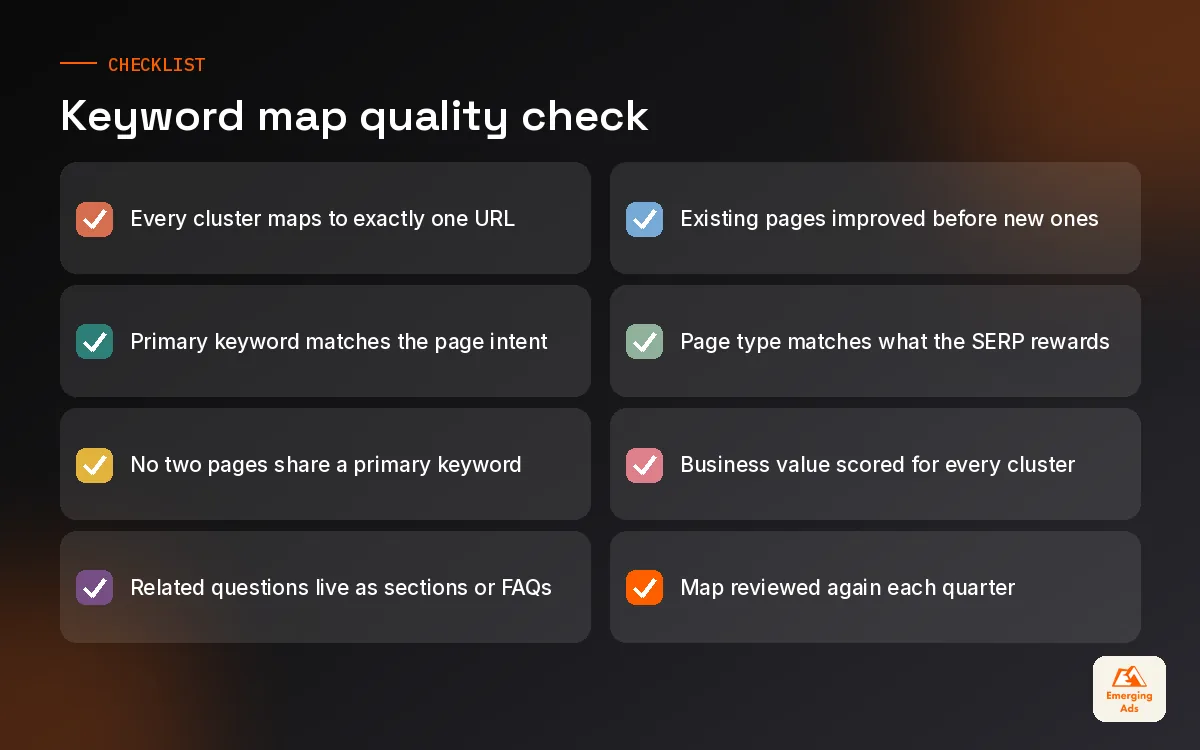
Google understands that “emergency plumber”, “24 hour plumber” and “plumber open now” are the same need. One strong page can rank for all of them. Clustering groups keywords that share intent and would be satisfied by the same page, so you build one excellent page instead of five thin ones.
How we cluster in practice
- Group keywords that share the same core intent and topic, ignoring small wording differences.
- Check overlap: if the same URLs rank on page one for two keywords, they probably belong in one cluster.
- Name each cluster by its strongest commercial term, which usually becomes the page’s primary keyword.
- Split a cluster when the results pages differ, for example one wants a guide and another a product listing.
- Attach related questions to each cluster as sections or FAQs rather than separate pages.
Longer, more specific searches often slot neatly into an existing cluster as a section or FAQ. They deserve their own page only when the results show a dedicated page winning. We will cover long tail keywords in detail later in this series. Clustering is also where keyword research turns into a content plan, which is why it feeds straight into our content strategy services for clients who want the writing handled too.
07Step 6: Map keywords to pages and set priorities
The final stage is the one that makes keyword research useful. Every cluster gets mapped to exactly one URL on your site. Either that page exists and needs improving, or it does not and needs building. Two pages mapped to the same cluster is a warning sign for cannibalisation, where your own pages compete and neither ranks as well as one would.
A simple keyword map
| Cluster | Primary keyword | Target URL | Status | Priority |
|---|---|---|---|---|
| Emergency plumbing | emergency plumber [city] | /emergency-plumber/ | Exists, thin | 1 |
| Boiler repair | boiler repair [city] | /boiler-repair/ | Exists, good | 3 |
| Boiler replacement cost | new boiler cost | None | Build | 2 |
| Leak detection | leak detection service | None | Build | 2 |
Improving an existing page usually moves faster than publishing a new one, because the URL already has some history and internal links. So our first month on a new account is often spent fixing mapped pages that already sit on page two. The on-page side of that work (titles, headings, internal links and content depth) is what our on-page SEO services cover. A mapped keyword also needs a page Google can crawl and index, which is why we suggest reading our technical SEO field guide alongside this one.
Priorities by business type
- Local service businesses: service plus location pages first, then problem-led guides. Our local SEO services pair this with Google Business Profile work.
- SaaS and B2B: comparison, alternative and integration pages first, as these catch buyers mid-decision. We run this alongside SaaS campaign management so paid and organic share keyword data.
- Ecommerce: category pages carry the commercial terms, product pages the specific model searches, and buying guides the research phase.
08Keeping your keyword research alive
Keyword research is not a one-off project. Search behaviour shifts, competitors publish, and your own Search Console data grows richer every month. We revisit the map quarterly: which pages gained impressions for terms we did not target, which clusters stalled, and which new questions appeared in sales calls. For competitive markets, a quick look at what rivals have started ranking for, using a tool such as Similarweb competitor research, often flags a new cluster before it shows up anywhere else.
If you would rather hand the whole process to a team that does this daily, see everything we offer on our services page, or explore the rest of this series from the EmergingAds SEO blog homepage.
Frequently asked questions
Straight answers to what clients ask us most about keyword research.
What is keyword research?
How long does keyword research take?
Which keyword research tool is best?
Should I target high volume keywords?
How accurate are keyword volume numbers?
What is search intent and why does it matter?
How many keywords should one page target?
What is keyword cannibalisation?
Can I do keyword research for a brand new website?
How often should keyword research be updated?
Is keyword research still relevant with AI search?
Not sure which keywords are worth your budget?
We will map your existing pages to the searches that bring buyers, flag the gaps and show you which three pages to build next.
Book your free audit