SEO Strategy Explained Step by Step (2026 Edition)
An SEO strategy is a set of choices about where to compete, what to fix first and how you will know it is working. Here is the step-by-step process we use with new clients, from the first goals conversation to the monthly report.

Key takeaways
- A useful SEO strategy starts from business goals and margins, not from a list of high-volume keywords.
- Audit technical health, content and authority before planning, so you know which constraint is really holding you back.
- Choose battles you can win: topics where intent matches your offer and competitors are beatable within a year.
- Split effort across technical, content and authority work according to your bottleneck, and review the split each quarter.
- Report with Search Console and a Looker Studio dashboard tied to leads or revenue, and forecast in ranges rather than promises.
01What an SEO strategy is, and why most of them fail
An SEO strategy is a written set of decisions: which searches you want to win, which pages will win them, what has to be fixed first and how you will judge progress. That is it. The documents we inherit from previous agencies are often forty pages of audit screenshots and keyword exports with no decisions in them at all.
The failure pattern is familiar. A B2B software firm we took on last year had a “strategy” built around a head term with enormous search volume. They had spent a year writing around it and ranked on page four. Meanwhile, their sales team was closing deals from people searching for integration-specific terms that nobody had written a single page for. The strategy was chasing volume, not buyers.
A good SEO strategy fits on a page or two, names its trade-offs and changes when the evidence does. Everything in this guide is about getting to that page.
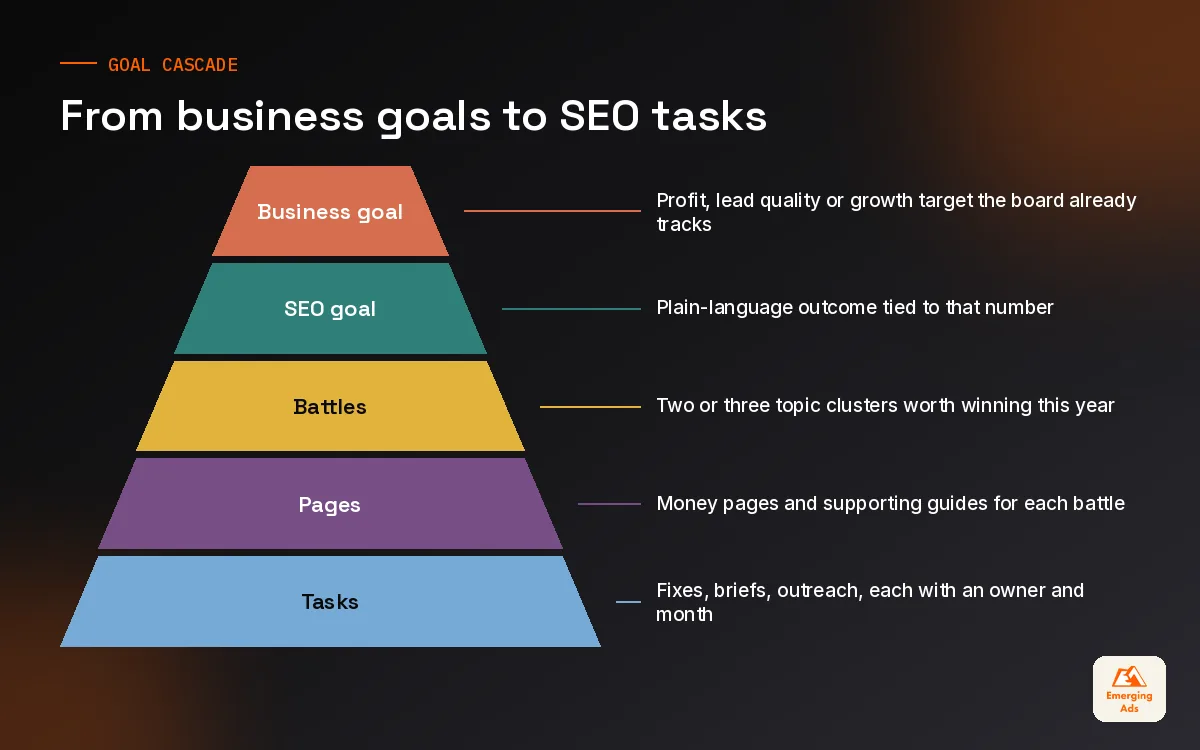
02Step 1: Turn business goals into SEO goals
We never start with keywords. We start with a conversation about the business: what sells, what has margin, what capacity the team has and what the next twelve months look like. An ecommerce client with a bestselling product line on thin margin and a smaller, profitable line needs a different plan from one where every product earns the same.
Questions we ask in the first meeting
- Which products, services or locations bring in the most profit, not just revenue?
- What does a qualified lead or a good order look like, and what is it worth?
- Where does the sales team hear the same questions again and again?
- What is changing: new markets, new products, a site rebuild, a price change?
- How much can your team write, approve and publish each month in reality?
From that we write two or three SEO goals in plain language, for example: “grow qualified demo requests from organic search for our two core integrations” or “win the local pack in our five clinic towns for our three highest-value treatments”. Each goal ties to a number the business already tracks.
| Business goal | Weak SEO goal | Strong SEO goal |
|---|---|---|
| More demo requests | Rank for “CRM software” | Grow organic demo requests from integration and comparison pages |
| Fill clinic diaries | Get more traffic | Win local visibility for top treatments in each clinic town |
| Grow ecommerce revenue | Publish four blogs a month | Lift organic revenue from the ten highest-margin category pages |
| Enter a new country | Translate the site | Build localised category and service pages for the new market |
03Step 2: Audit where you stand today
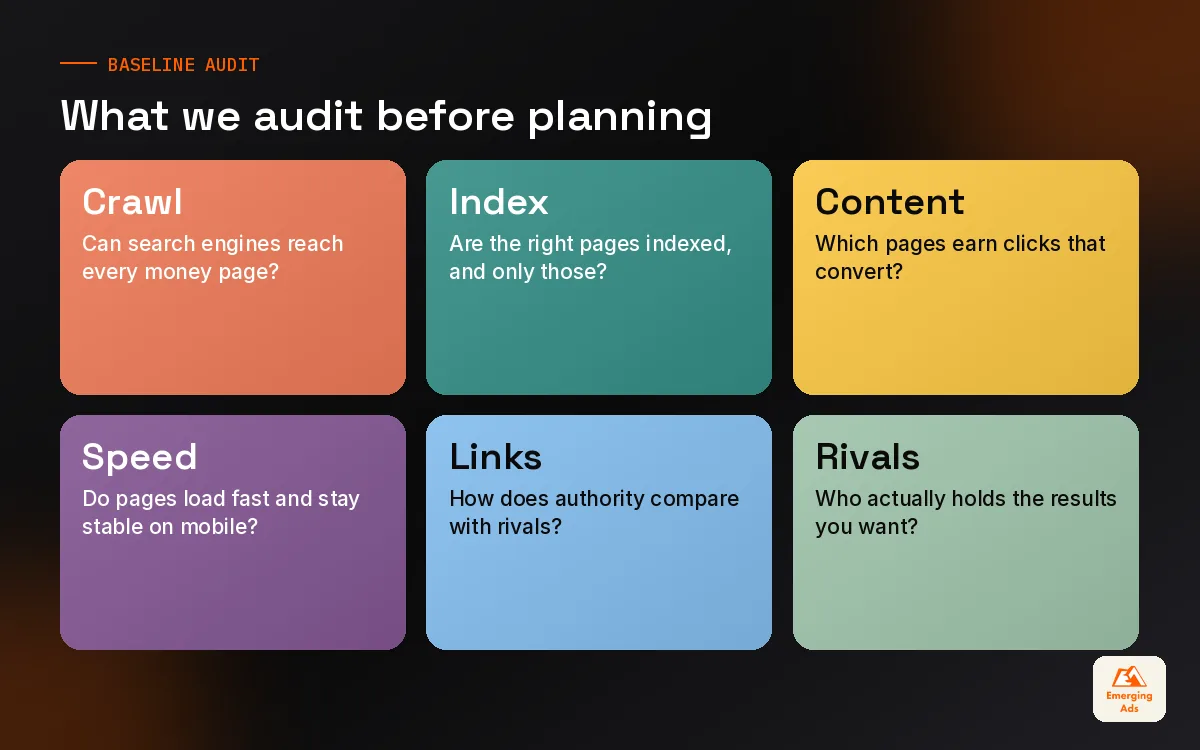
Before planning, we need an honest baseline across three areas: technical health, content and authority. The point is not to list every issue. It is to find the constraint that is actually capping growth.
Technical health
We crawl the site, usually through our Screaming Frog technical audit, and cross-check it with the page indexing and Core Web Vitals reports in Google Search Console. We are looking for things that stop good pages being found or indexed: blocked sections, redirect chains, duplicate templates, orphaned money pages. Our technical SEO field guide covers this in depth, so here we only need the headline: is technical health a blocker or not?
Content
We export Search Console performance data for the last twelve months and map every page to a purpose. Some pages earn clicks that convert. Some earn clicks that never do. Many earn nothing at all. On a Shopify fashion store we audited, more than half the blog posts had no clicks in a year, while two category pages drove most of the organic revenue. That told us where the next quarter should go.
Authority
We compare referring domains and the quality of those links against the sites that outrank you. If you have a clean site and strong content but a fraction of your competitors’ authority, content alone will not close the gap, and link building moves up the plan.
04Step 3: Find the gaps your competitors leave open
Your real competitors in search are not always your commercial competitors. A regional law firm we work with found that their toughest search rivals were two legal information sites and a directory, not other firms. Your SEO strategy has to plan against whoever holds the results you want.
How we run a competitor gap analysis
- List the 20 to 30 searches closest to revenue and note who ranks in the top five for each.
- Pick the three to five domains that appear most often; those are your search competitors.
- Use a tool such as Similarweb or an SEO suite to export the keywords they rank for and you do not.
- Filter that list for intent that matches your offer, then group it into topics.
- For each topic, note what the ranking pages do well and what they miss: depth, freshness, format, proof.
The misses are where you win. Often it is a format gap: everyone ranks with a thin list article, and nobody has a proper comparison table, a calculator or a genuine walkthrough. Sometimes it is an audience gap, like a topic nobody has written for small businesses specifically. Our keyword research guide explains the intent and clustering side of this in more detail, and our keyword research team can do the heavy lifting if your team is stretched.
The best gap is the one your competitors cannot fill quickly, because it depends on knowledge only you have.
05Step 4: Choose your battles
This is the step that turns research into an SEO strategy. You cannot chase every topic at once, so we score each topic cluster on two things: business value and how winnable it is in the next twelve months.
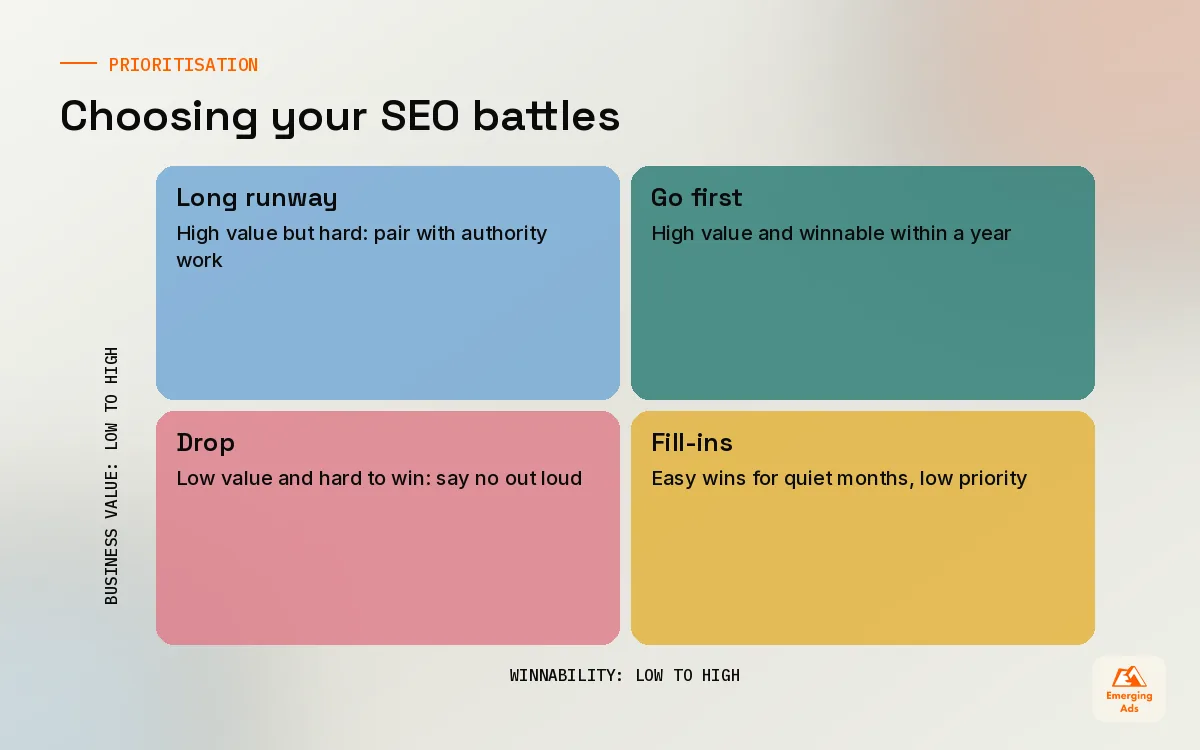
Business value comes from Step 1: margin, lead quality, sales cycle. Winnability comes from Steps 2 and 3: how strong the ranking pages are, how much authority you have in that topic already and how much work the page needs. Topics that are high value and winnable go first. High value but hard topics get a longer runway with authority work behind them. Low value topics, however much traffic they promise, mostly get dropped.
An example of choosing battles
A multi-location physiotherapy group wanted to rank nationally for broad injury terms. Those results were owned by health publishers with huge authority. We moved the effort to treatment pages for each clinic town and a handful of detailed condition guides written by their own clinicians. Bookings from organic search grew steadily, and the national ambition was parked for year two rather than abandoned.
06Step 5: Split effort between technical, content and authority
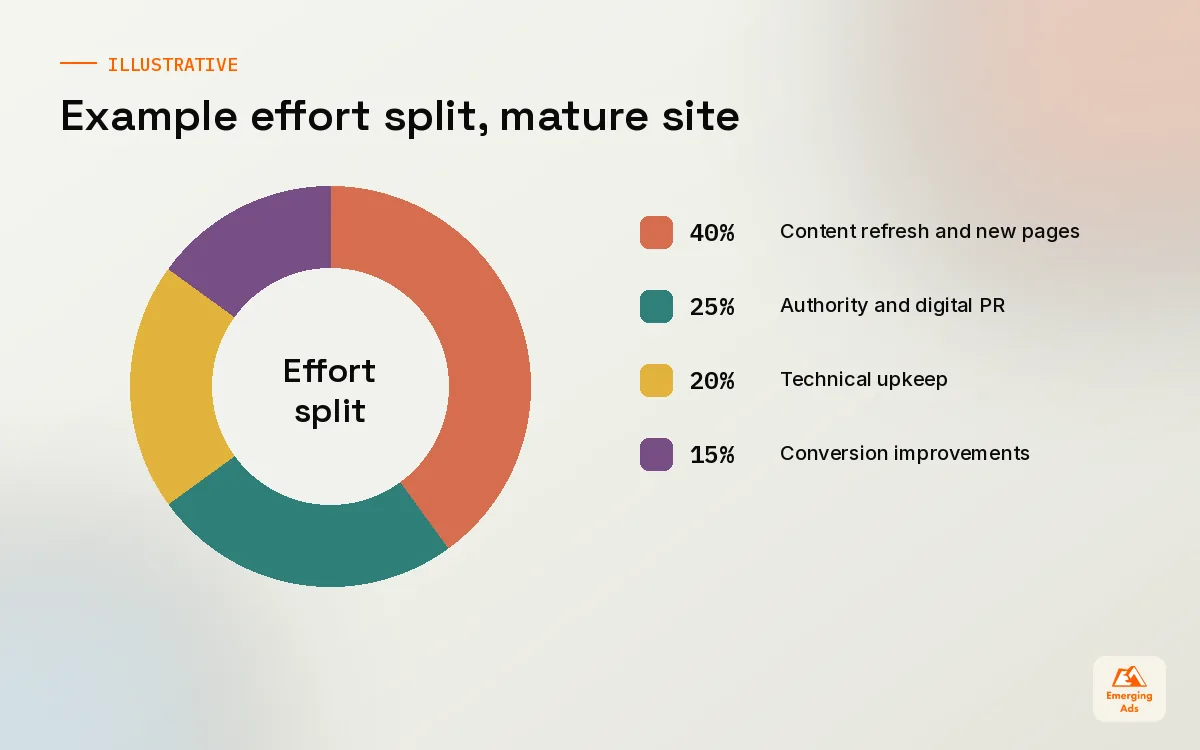
Every SEO strategy has to decide how hours and budget get divided. There is no universal split. It follows your bottleneck, and it changes as you fix things.
| Situation we find | Likely split (illustrative) | Why |
|---|---|---|
| New site, little content | Light technical, mostly content, some authority | Nothing to rank yet; pages come first |
| Big site with crawl or index issues | Mostly technical, some content | Good pages are being wasted by the plumbing |
| Strong content, few links | Some content, mostly authority | Pages are ready but not trusted enough |
| Mature site, flat growth | Balanced, with focus on refreshes and conversion | Existing pages are the fastest wins |
That last row deserves a note. On mature sites, some of the best returns we see come from improving what already ranks: refreshing out-of-date pages and fixing weak landing pages through conversion rate optimisation. More traffic to a page that does not convert is a slow way to grow.
07Step 6: Build a 12-month SEO roadmap
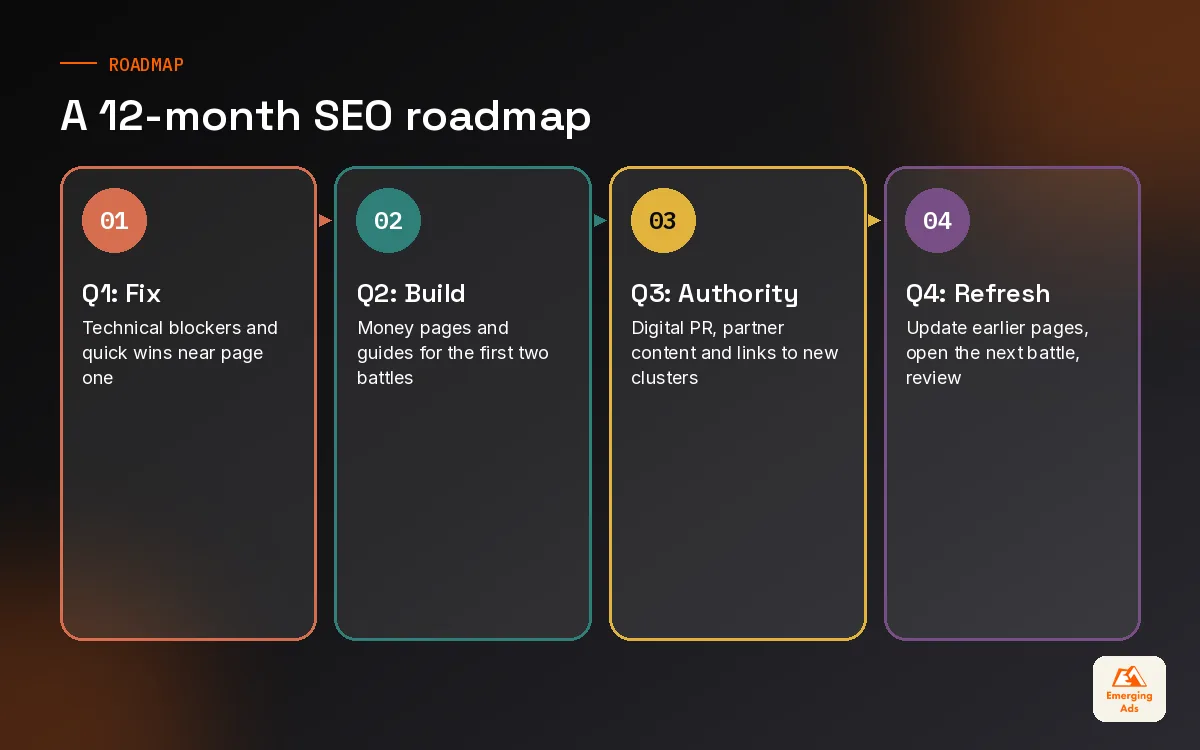
The roadmap turns choices into a sequence. We plan in quarters, detail the first one properly and keep the rest lighter, because what we learn in months one to three always changes months four to twelve.
| Quarter | Focus | Typical outputs |
|---|---|---|
| Q1 | Fix blockers and quick wins | Technical fixes, title and internal link updates on pages ranking just off page one |
| Q2 | Build the priority topic clusters | New money pages and supporting guides for the first two battles |
| Q3 | Grow authority | Digital PR, partner content and links to the new clusters |
| Q4 | Refresh, expand and review | Update Q1 and Q2 pages, open the next battle, plan next year |
Two habits keep the roadmap alive. First, every item has an owner and a month, not just a description. Second, we hold a quarterly review where we look at what moved, what did not and whether the split from Step 5 still makes sense. On our services side, this is where SEO often starts to connect with content, CRO and paid search planning.
AI answer engines belong in the roadmap too. We add a light layer of answer-first rewrites and brand mention work to most plans now, following the approach in our generative engine optimization playbook.
08Step 7: Report and forecast honestly
Reporting is where trust is won or lost. We build every client report around the goals from Step 1, not around the metrics that happen to look good that month.
What goes in the monthly report
- Outcome metrics: organic leads, orders or revenue from GA4, split by the priority topics.
- Search visibility: clicks, impressions and average position from Search Console for the pages in each battle.
- Work delivered: what shipped, what slipped and why.
- Next month: the three or four things that matter most, in order.
We pull this into a Looker Studio dashboard so clients can check it any day, not just when the report lands. For clients with lots of data sources, Supermetrics saves hours of manual exports.
Forecasting without making things up
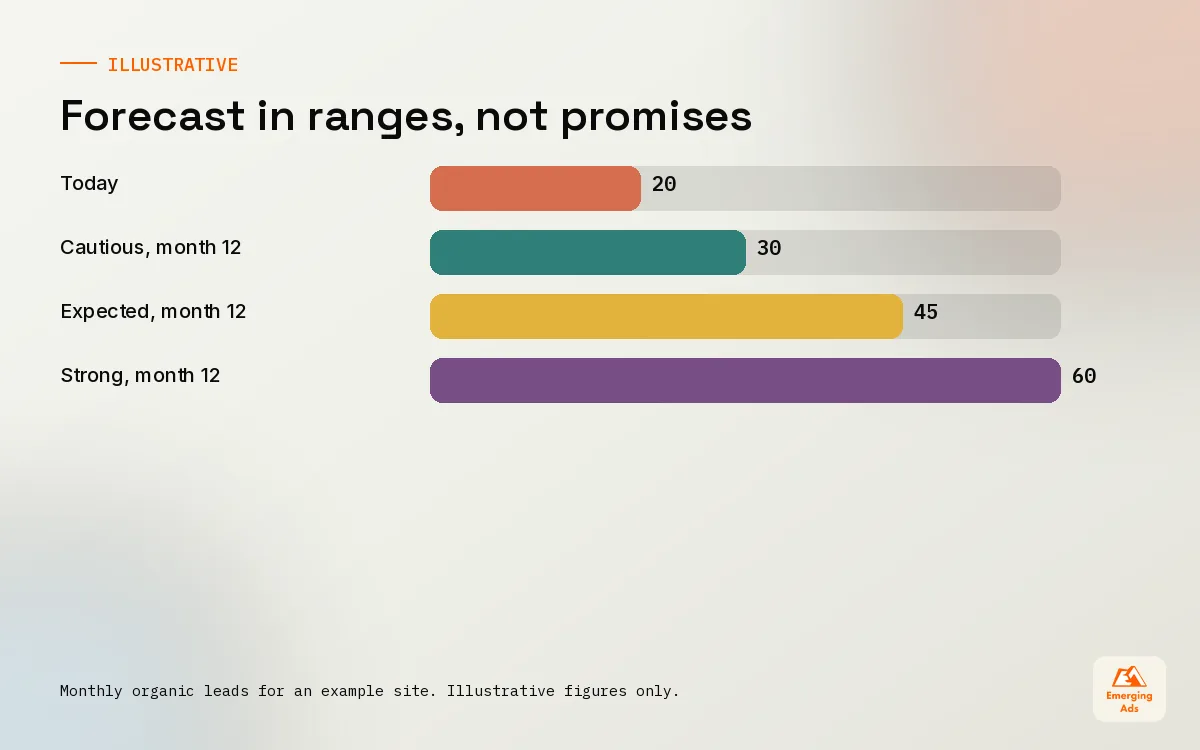
We forecast in ranges and show our working. For a topic cluster, we estimate searches from keyword tools, apply a realistic click-through range for the positions we think are achievable and multiply by your current organic conversion rate. We present a cautious, expected and strong scenario, and we say plainly what would have to be true for each. If someone promises you a single precise traffic number twelve months out, ask them to show the maths.
09Getting started with your own SEO strategy
If you are building an SEO strategy in-house, start small: one page listing your business goals, your three biggest search competitors, the two or three battles you are choosing and the ones you are not. Then plan the first quarter in detail. That single page will do more for you than a forty-page audit.
For more hands-on guides from the same team, visit the usemergingads.com homepage. And if you would rather have a senior team build and run the plan with you, that is exactly what our search work is built for.
Frequently asked questions
Straight answers to what clients ask us most about seo strategy.
What should an SEO strategy include?
How long does an SEO strategy take to work?
How do I create an SEO strategy for a small business?
How often should an SEO strategy be reviewed?
What is the difference between an SEO strategy and an SEO audit?
Which tools do I need for SEO strategy work?
How do I measure whether my SEO strategy is working?
Should content or link building come first?
Can I forecast SEO results accurately?
How does AI search change SEO strategy in 2026?
Do I need an agency to build an SEO strategy?
Need an SEO strategy you can actually defend to your board?
We will audit where you stand, map the gaps against your real competitors and hand you a 12-month plan with honest forecasts, not a slide of vanity keywords.
Book your free audit