The Practical Generative Engine Optimization Playbook We Hand to New Clients
Generative engine optimization is not a new religion. It is good SEO with sharper edges: clearer answers, stronger entities and proof that other people talk about you. This is the playbook we run on client sites, including the parts we tell clients to ignore.
Key takeaways
- Generative engine optimization builds on SEO fundamentals: if search engines cannot crawl, index and trust a page, AI answer engines rarely cite it.
- Pages that get cited answer one question clearly near the top, name entities precisely and carry something original, such as your own data or a strong opinion.
- Brand mentions on other sites, reviews and forums shape how AI answers describe you, so digital PR and reputation work now feed search directly.
- Track AI referrals in GA4 with a custom channel group and test a fixed prompt set monthly, rather than chasing screenshots.
- Ignore anyone selling guaranteed AI rankings, secret files or prompt hacks. Platforms change fast; clear, trustworthy content keeps working.
01What generative engine optimization means on a real client account
When a founder asks us about generative engine optimization, the question behind it is usually simpler: “When someone asks ChatGPT or Google’s AI Overview about our category, why does a competitor get named and we do not?” That is the problem this guide solves. Generative engine optimization, or GEO, is the work of making your brand and your pages the source that AI answer engines pick, quote and link when they write a response.
If you want the background on what GEO is and why it matters, our main site has a primer on what generative engine optimization is. This post is the hands-on version: the checks, page patterns and tracking setup we use on client sites every week, from Shopify stores to B2B software firms to multi-location clinics.
One thing first. Almost every GEO win we have seen started as an SEO fix. A payroll software client came to us convinced they needed an “AI strategy”. Their product pages were rendered with JavaScript that crawlers struggled with, and half their help centre was blocked in robots.txt. We fixed the plumbing, rewrote twelve key pages to answer questions directly, and within a couple of months their brand started appearing in AI answers for comparison queries. No magic, just search engine optimisation done properly with a new audience in mind.
02How AI answer engines choose which sources to cite
We keep this section deliberately general, because the platforms change their behaviour often and anyone quoting you exact ranking factors for ChatGPT, Perplexity, Gemini or Google’s AI Overviews is guessing. What has stayed stable across the accounts we watch is the broad shape of how these systems work.
Retrieval first, writing second
Most AI answer engines that show sources do two jobs. First they retrieve: they search an index of the web, often using a conventional search system or something close to it, and pull back a handful of candidate pages. Then they generate: a language model reads those candidates and writes an answer, citing the pages it drew on. Your page has to survive the first step before the second step even sees it. That is why rankings, crawlability and indexation still matter so much.
What seems to earn the citation
- A clean, extractable answer. Pages that state the answer in a sentence or two near the relevant heading are easier to quote than pages that bury it under a long intro.
- Specific entities. Named products, places, standards and people give the model something concrete to match against the question.
- Corroboration. When several independent sources say similar things about your brand, the model has more confidence repeating it.
- Freshness where it matters. For pricing, software features and regulations, recently updated pages tend to be preferred on the accounts we track.
- Something the other sources lack. Original data, a clear methodology, a worked example or a firm opinion gives the model a reason to cite you rather than the tenth page saying the same thing.
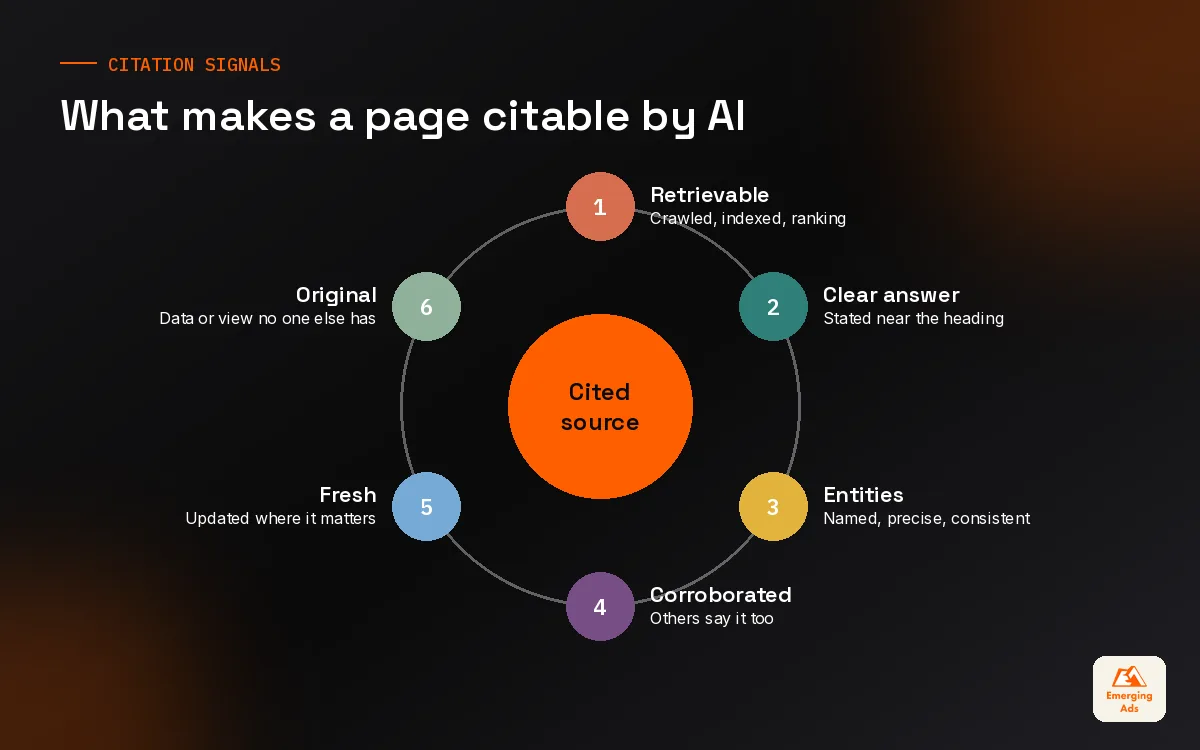
Notice what is missing from that list: keyword density, word count targets and special markup tricks. We have tested plenty of those on our own properties. None of them moved citations on their own.
03Making your pages citable: the page patterns we use
This is where most of the hours go. We audit a client’s top pages against a simple question: if a model had ten seconds with this page, could it lift a correct, complete answer from it? Usually the answer is no, and the fix is editorial, not technical. Our content strategy team handles most of this work, and it is also where on-page SEO and GEO overlap heavily.
The answer-first block
Under each key heading, we write one or two sentences that answer the heading’s question outright, then expand. A physiotherapy clinic group we work with had a page titled “Shockwave therapy” that opened with the clinic’s history. We rewrote the opening to say what the treatment is, who it tends to suit and what a course usually involves, in plain words. The rest of the page stayed. That page now gets quoted in AI answers for local treatment questions, where before it never did.
Question-shaped headings
People ask AI assistants full questions. Headings that mirror those questions, such as “How long does a Shopify migration take?”, make it easy for retrieval systems to match a passage to a prompt. We do not turn every heading into a question, as that reads badly, but we make sure the five or six questions buyers actually ask have a clear home.
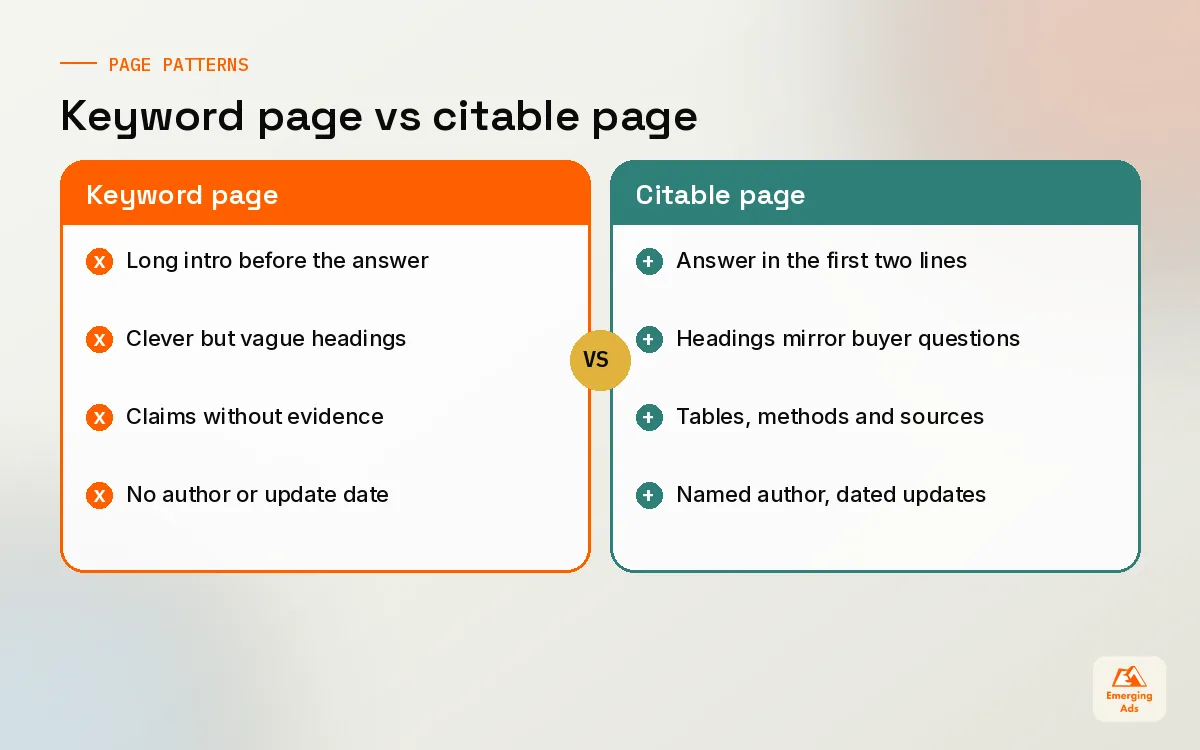
| Page element | Weak version we often find | Citable version we write |
|---|---|---|
| Opening paragraph | Brand story and mission statement | Direct answer to the page’s main question in two sentences |
| Headings | Clever labels like “Our approach” | Buyer questions or clear topic labels |
| Comparisons | Vague claims of being “the best” | A table with named options, criteria and honest trade-offs |
| Evidence | Stock testimonials | Named methods, dated examples, original numbers with source |
| Author | “Admin” or no byline | Named author with role and relevant experience |
| Updates | No date, stale pricing | Visible last-updated date and current details |
Tables, lists and definitions
Comparison tables are some of the most cited elements we see. A B2B client selling compliance software added a plain table comparing the three main approaches to their problem, including the ones they do not sell. Within weeks that table was paraphrased in AI answers, with a link back. Being fair to alternatives made the page more trustworthy, not less.
04Entities, brand mentions and why your reputation is now an SEO asset
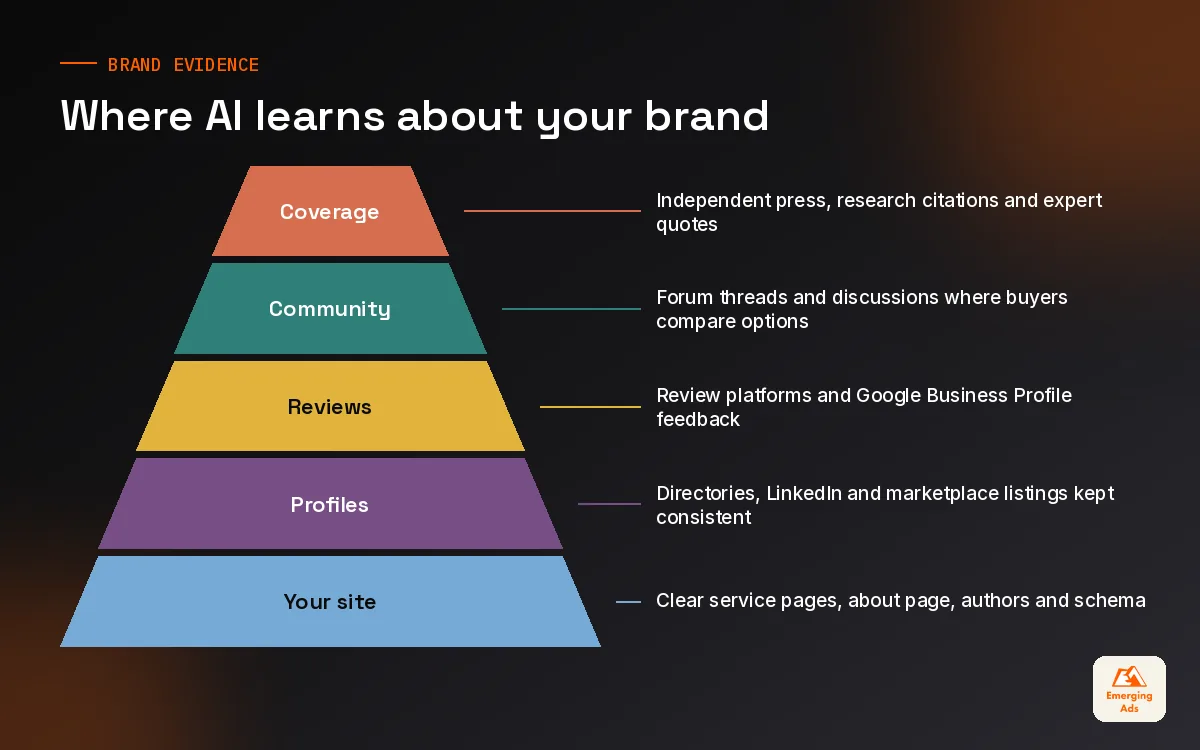
Here is the part of generative engine optimization that surprises clients most. A lot of what an AI answer says about your brand is shaped by pages you do not own: review sites, industry directories, forum threads, comparison articles and news coverage. The model is summarising the web’s opinion of you.
Get your entity story straight
Start with consistency. Your company name, what you do, where you operate and who you serve should read the same on your site, your Google Business Profile, LinkedIn, key directories and your brand messaging. We once found a DTC skincare brand described in three different ways across the web because they had pivoted twice. AI answers mixed all three descriptions together. Cleaning up the old descriptions took a month of unglamorous outreach and profile updates, and the answers tidied up after that.
Earn mentions, not just links
Classic link building still matters because links help pages rank, and ranking pages get retrieved. But for GEO, unlinked mentions in credible places carry weight too. Being named in an industry roundup, quoted in a trade publication or recommended in a relevant community thread all add to the picture. Our link building guide covers digital PR in detail; the GEO twist is that we now track mentions alongside links.
- Audit which third-party pages AI answers cite for your category, then ask how you get included there.
- Respond to reviews publicly and specifically, since review text often gets summarised.
- Contribute genuinely useful answers in communities where your buyers ask questions, under your real name.
- Publish original research others will want to reference, even a small survey of your own customers.
05Structured data, crawler access and the technical checklist
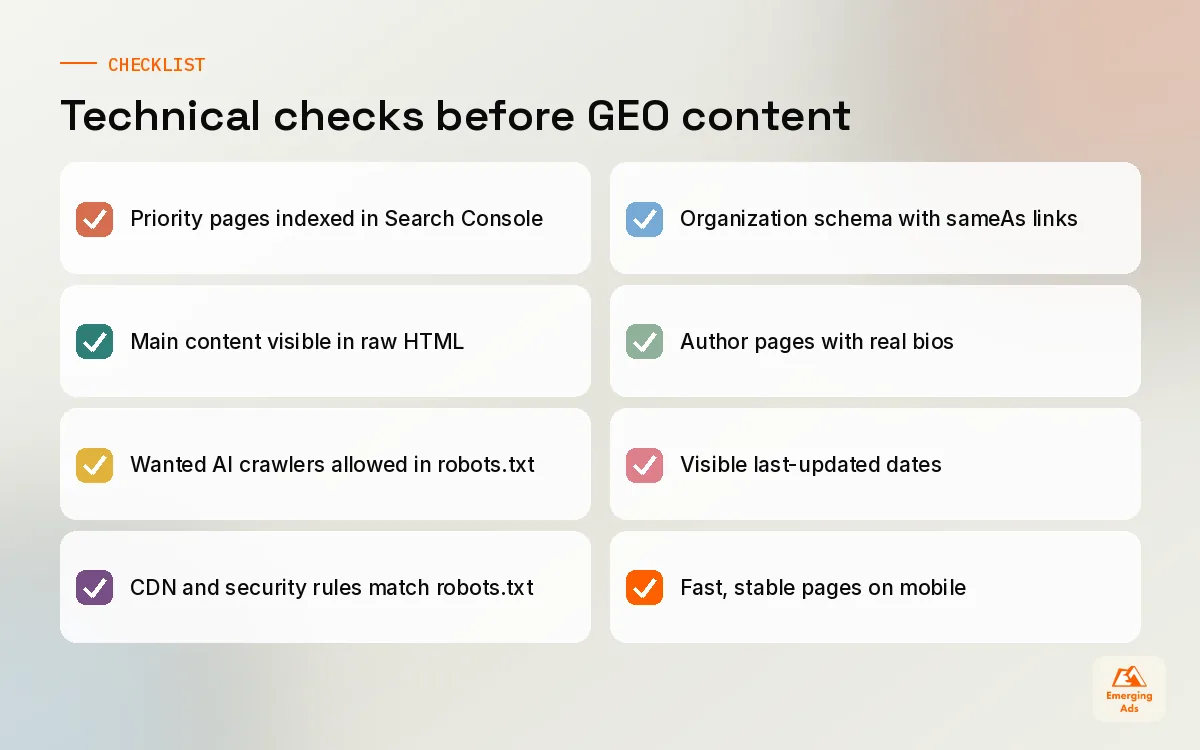
The technical side of generative engine optimization is short, but skipping it wastes the content work. These are the checks we run on every new client before touching copy.
Let the right crawlers in
Several AI companies run their own crawlers, and each publishes a user agent you can allow or block in robots.txt. Some clients choose to block AI training crawlers while allowing search-related ones; that is a business decision, and we lay out the trade-offs rather than make it for them. What we do insist on is checking. More than once we have found a security plugin or CDN rule quietly blocking crawlers the client wanted to allow.
Structured data that describes, not decorates
Schema markup such as Organization, Product, Article, FAQPage and LocalBusiness helps machines understand what a page is about and who is behind it. We treat it as a clarity tool, not a ranking lever. Mark up what is genuinely on the page, keep it accurate, and connect your Organization markup to your official profiles with sameAs. If your site is on a builder that makes this painful, it may be worth a look from our web development team.
| Check | Why it matters for AI answers | How we test it |
|---|---|---|
| Pages indexable | Unindexed pages are rarely retrieved | Search Console page indexing report |
| Content in raw HTML | Some crawlers render little or no JavaScript | View source and compare with rendered page |
| AI crawlers allowed (if wanted) | Blocked bots cannot read the page | robots.txt plus server and CDN logs |
| Organization schema with sameAs | Ties your site to your official profiles | Rich Results Test and schema validator |
| Clear author pages | Supports trust and expertise signals | Manual review of bylines and bio pages |
| Fast, stable pages | Slow or broken pages frustrate every crawler | PageSpeed Insights and field data |
06Tracking AI referrals in GA4 without fooling yourself
Measurement is where GEO conversations go wrong fastest. Someone screenshots an AI answer mentioning the brand and declares victory, or the opposite. We prefer boring, repeatable numbers, set up through our GA4 setup service or in-house if your team is comfortable.
Build an AI channel group
In GA4 you can create a custom channel group and add a channel that matches sessions from AI referrers using a regex on the session source. We include domains such as chatgpt.com, perplexity.ai, gemini.google.com and copilot.microsoft.com, and review the list each quarter as new sources appear in the referral report. Put the channel above Referral in the order so those sessions do not get swallowed.
- Admin, then Data display, then Channel groups, then create a new group copied from the default.
- Add a channel called AI Assistants with a condition on session source matching your regex.
- Move it above Referral and save.
- Build an Exploration comparing AI Assistants against Organic Search on engagement and conversions.
Know what you cannot see
Plenty of AI influence never shows up as a referral. Someone reads an answer, remembers your name and searches for you later, so the visit lands as branded organic or direct. Google has also said clicks from its AI features in Search are counted within normal web search data in Search Console rather than broken out. So we pair referral data with branded search trends and a monthly prompt test.
Run a fixed prompt panel
We agree 20 to 40 buyer questions with the client, run them through the main answer engines each month, and log whether the brand is mentioned, cited with a link, or absent, plus which competitors appear. Tools like Semrush and Ahrefs now offer AI visibility tracking that helps at scale, but a manual panel keeps everyone honest about what buyers actually see.
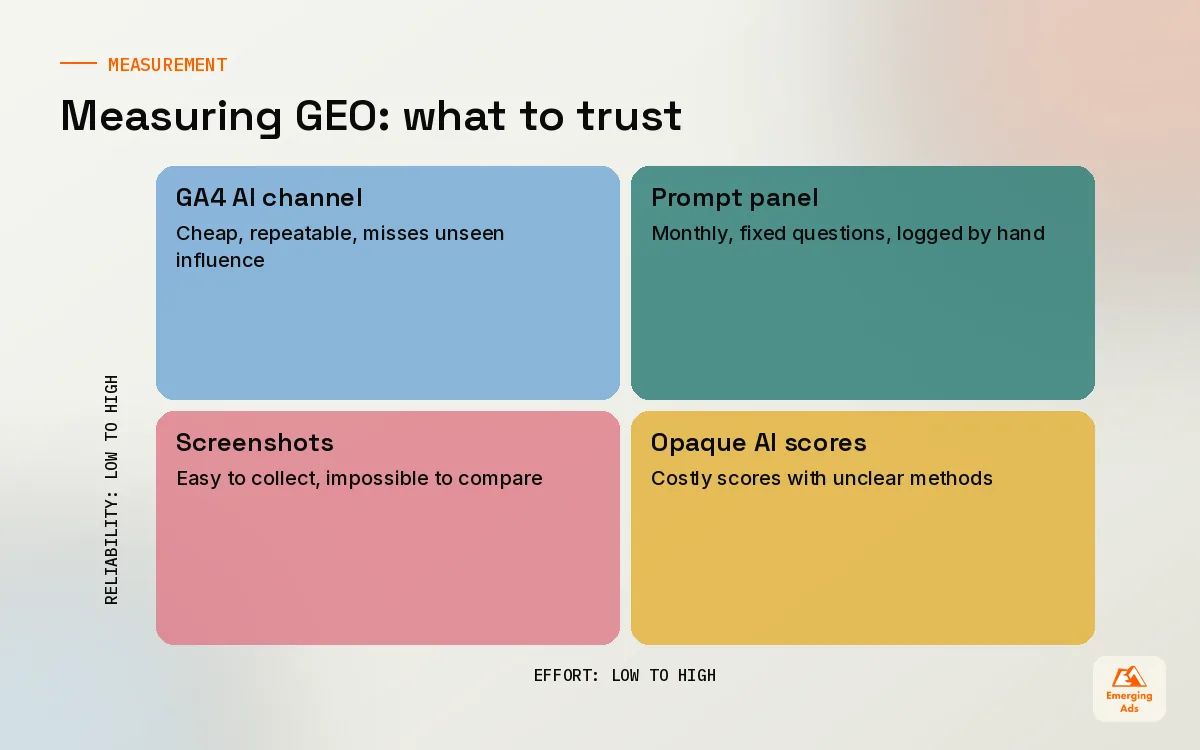
If you cannot measure it the same way twice, you are not tracking GEO, you are collecting screenshots.
07A 90-day generative engine optimization plan
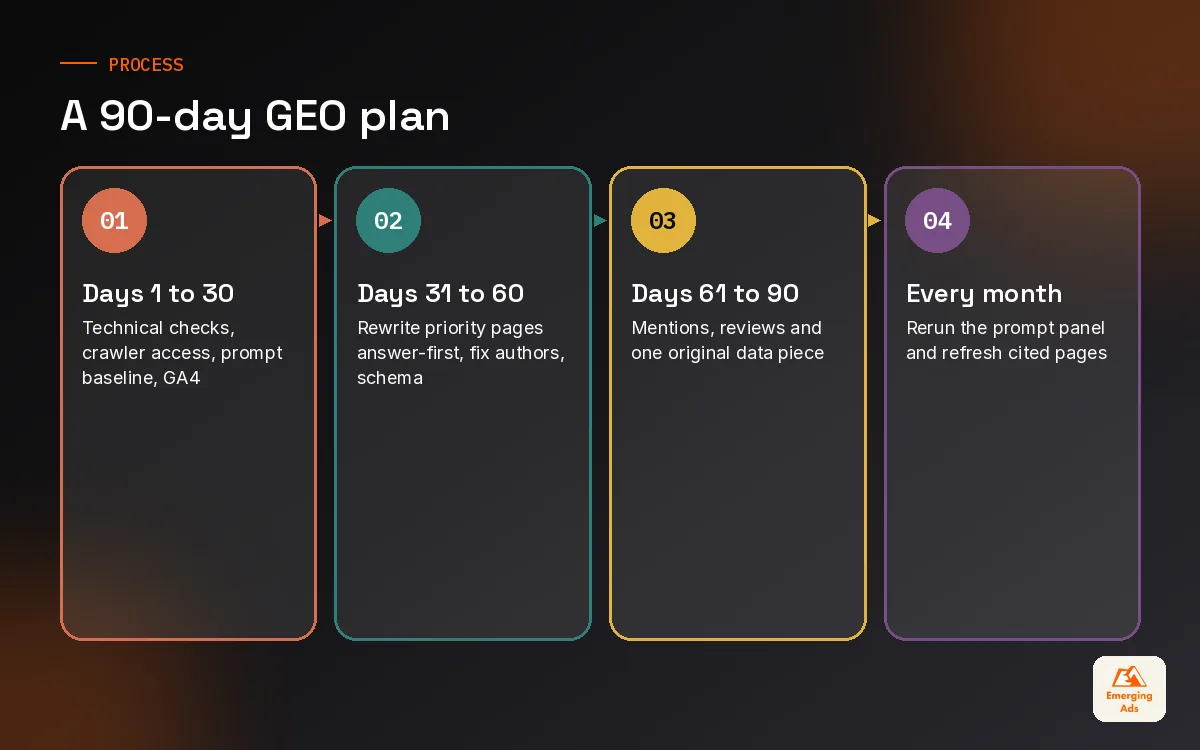
This is roughly how we phase the work for a new client. Smaller sites move faster; large ecommerce catalogues take longer on the technical side.
| Phase | Main work | What you should have at the end |
|---|---|---|
| Days 1 to 30 | Technical checks, crawler access, prompt panel baseline, GA4 channel group | A clear picture of where you appear today and what blocks you |
| Days 31 to 60 | Rewrite 10 to 20 priority pages answer-first, add comparison tables, fix author pages and schema | Your most important questions answered cleanly on your own site |
| Days 61 to 90 | Mention and review work, one original data piece, refresh stale pages | Third-party proof starting to build and a repeatable monthly routine |
The routine after day 90 matters more than the sprint. We rerun the prompt panel monthly, refresh the pages that answer engines cite most, and keep feeding original material into the content calendar.
08What not to believe about GEO
The noise around generative engine optimization is loud, and some of it is expensive. Here is what we tell clients when a new tactic lands in their inbox.
- “We guarantee your brand in ChatGPT answers.” Nobody controls that. Answers vary by prompt, user, location and date.
- “Add this special file and AI will find you.” Files like llms.txt are proposals. We have not seen them change citations on sites we manage, though adding one is harmless.
- “Write for robots now.” Pages written only for machines read badly to humans, and humans still make the purchase.
- “SEO is dead.” Retrieval still leans heavily on search indexes. The fundamentals carry more weight, not less.
- “Mass-produce AI content to cover every question.” Thin, samey pages are exactly what models skip in favour of original sources.
09Where to start this week
If you do three things this week, make them these. Run your top ten buyer questions through two or three answer engines and write down who gets cited. Check that your key pages are indexed and readable without JavaScript. Then rewrite the opening of your single most important page so it answers the main question in two plain sentences.
If you would rather hand it over, our full list of services shows how GEO sits alongside technical SEO, content and reporting in the way we work. You can also browse more practical guides on the usemergingads.com homepage, including our on-page SEO field guide, which pairs closely with the page patterns above.
Frequently asked questions
Straight answers to what clients ask us most about generative engine optimization.
What is generative engine optimization in simple terms?
Is GEO different from SEO?
How long does generative engine optimization take to show results?
Can I pay to appear in AI Overviews or ChatGPT answers?
Should I block AI crawlers in robots.txt?
Does schema markup help with AI search visibility?
How do I track traffic from ChatGPT and other AI tools in GA4?
What kind of content gets cited most by AI answer engines?
Do I need an llms.txt file?
How is answer engine optimization related to GEO?
Can a small business compete in AI search against big brands?
Want to know how AI answer engines describe your brand?
We will run your key buyer questions through the main AI answer engines, show you who gets cited instead of you, and hand back a short list of fixes in priority order.
Book your free audit