Long Tail Keywords, Explained Step by Step for Sites That Need Traffic Now
Long tail keywords are where newer sites win their first real traffic. This is the step by step process we use with clients: where the phrases hide, how to decide between a section and a page, and how to tell it is working.
Key takeaways
- Long tail keywords are specific, lower volume searches with clearer intent, and together they often outweigh the head terms everyone fights over.
- Your own Search Console data, sales calls and support inbox are richer sources of long tail phrases than any tool’s suggestion list.
- Most long tail queries belong as sections on a strong existing page; only give a phrase its own page when the intent is genuinely different.
- Thin pages and cannibalisation are the two ways long tail programmes go wrong, and both come from writing one page per phrase.
- Measure long tail success by the number of queries a page ranks for, clicks and leads, not by one tracked position.
01What long tail keywords are (and why length is not the point)
Long tail keywords are the specific, lower volume searches that sit behind every broad topic. “Running shoes” is a head term. “Best running shoes for flat feet on concrete” is long tail. The name comes from the shape of a search demand curve: a handful of phrases with huge volume at the head, then an enormous tail of phrases each searched rarely, which together add up to a large share of all searches.
People often define long tail keywords by word count, and that is where the confusion starts. Length is a side effect, not the definition. “Invisalign cost” is two words and fiercely competitive. “Can I get Invisalign with a crown” is longer, but what makes it long tail is that it is specific, the person asking it knows exactly what they want, and fewer sites have written a genuinely good answer. Specificity and intent are the point.
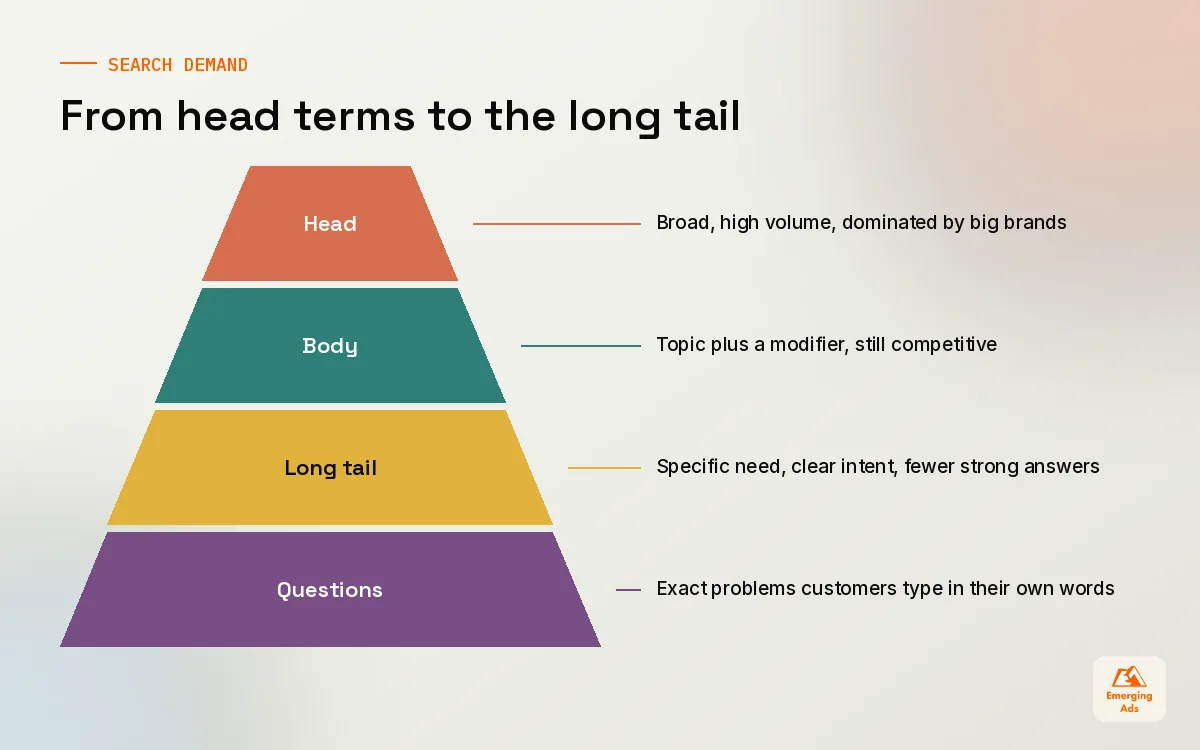
Head, body and tail in one example
| Layer | Example search | What the searcher wants | Who usually ranks |
|---|---|---|---|
| Head | project management software | Unclear: research, lists, definitions | Big brands, review sites |
| Body | project management software for agencies | A shortlist that fits their business type | Review sites, well-known SaaS brands |
| Long tail | project management tool that tracks retainer hours for agencies | A specific feature, close to buying | Often nobody with a direct answer |
| Long tail (question) | how to track retainer hours across multiple clients | A method, possibly a tool | Forums, a few blog posts |
This guide builds on our keyword research guide, which covers the full process from seed ideas to mapping. Here we zoom in on the tail: where to find it, what to do with it and how to measure it.
02Why long tail keywords work so well for newer sites
When a client comes to us with a site that is a year or two old and a handful of backlinks, we do not start by chasing head terms. The pages ranking for those have years of links and brand searches behind them. Long tail keywords give a newer site a way in, for three practical reasons.
- Weaker competition. Many long tail searches return pages that only half answer the question: a forum thread from years ago, a category page, a generic article that mentions the phrase once. A focused, genuinely useful answer can outrank them without a big link profile.
- Clearer intent. Someone searching “physio for rotator cuff after gym injury in Leeds” is further along than someone typing “physio”. The traffic is smaller and it converts far better.
- Compounding topical depth. Every long tail answer adds depth to a topic cluster. Over time, that depth and the internal links between those pages help the site compete for the broader body terms too.
A B2B software client of ours had spent a year trying to rank for their category’s head term and sat on page three. We pivoted to the specific workflow questions their sales team heard every week: integrations, migration worries, niche use cases. Within a couple of quarters, those pages were bringing in more demo requests than the head term would realistically have delivered, and the head term itself had started to move because the site now looked like the specialist it was. That pairs naturally with our SaaS marketing work, where the same phrases feed paid search.
03Where to find long tail keywords that real customers use
Keyword tools are useful, but they are the last place we look, not the first. Tools estimate volume from samples, and at the very end of the tail they often report zero for phrases that bring in steady clicks. The best long tail keywords come from your own data and your own customers.
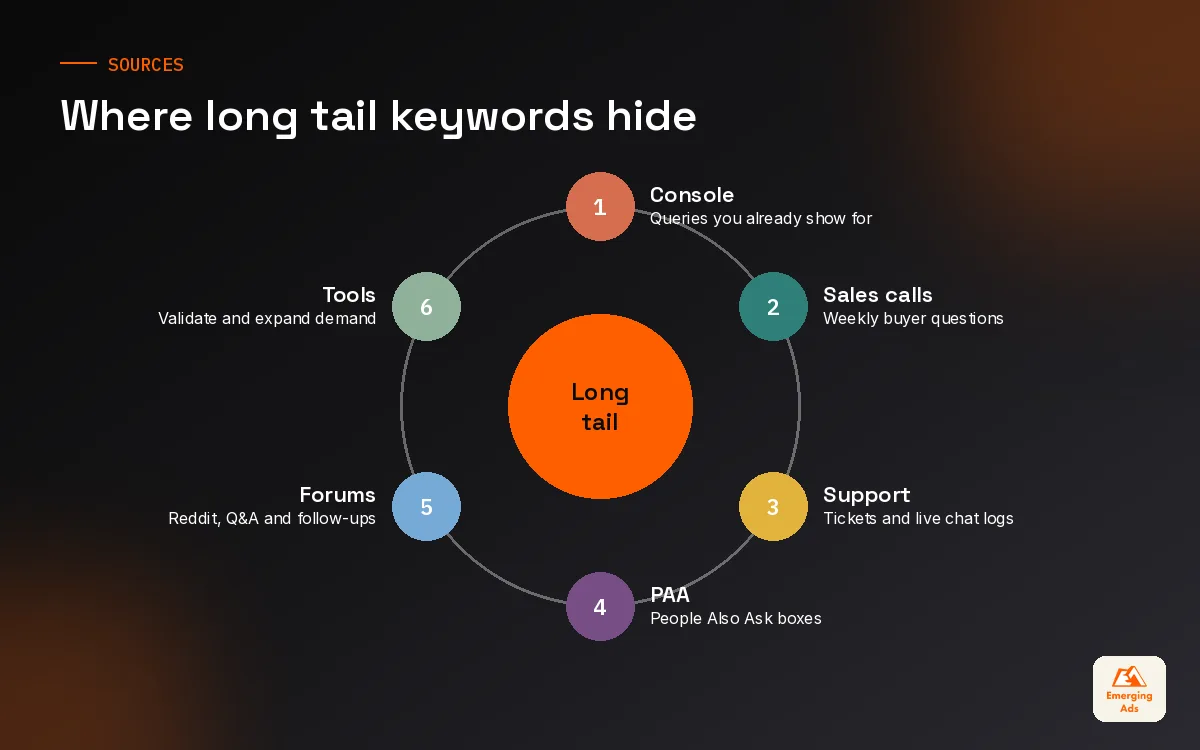
1. Search Console: the tail you already rank for
Open the Performance report in Search Console, choose a date range of at least three months, and look at queries rather than pages. Filter for queries containing words like how, what, which, best, vs, for, near, cost or can. Then sort by impressions. You will find dozens of specific phrases where you already appear on page two or three but get almost no clicks, because the page only brushes the topic. Those are your fastest wins. If you do not trust your Search Console setup, our Search Console service will get it verified, cleaned up and connected properly.
2. Sales calls, support tickets and the enquiry form
Ask your sales team for the ten questions they answer every week. Read the last fifty support tickets. Export the free text field from your enquiry form. The language customers use here is exactly how they type into Google, including the awkward phrasing no keyword tool will suggest. A dental clinic we work with found half their best content ideas in their receptionist’s notes on what people asked when they phoned.
3. People Also Ask, forums and Reddit
Search your main topics and expand the People Also Ask boxes several times; each click reveals more related questions. Then read forums, Reddit threads and Q&A sites in your niche. Pay attention to follow-up questions in the comments: that is where the real long tail lives, the “yes, but what if” questions that generic articles never cover.
4. Tools, used for validation and expansion
Once you have a list from real sources, tools earn their place. We use Semrush and Ahrefs to check which phrases have measurable demand, see what currently ranks, and find close variations. Question filters and the matching terms reports are the most useful features for tail research.
| Source | What it gives you | Time to mine | Our verdict |
|---|---|---|---|
| Search Console queries | Phrases you already get impressions for | An hour | Start here, always |
| Sales and support notes | Exact customer language and objections | Half a day | Richest source of intent |
| People Also Ask | Question variations Google already links | An hour | Great for FAQ and section ideas |
| Forums and Reddit | Edge cases and follow-up questions | Half a day | Best for depth and angles |
| Keyword tools | Volume estimates, competition, variations | An hour or two | Validate, do not originate |
04How to find long tail keywords with intent, step by step
Raw lists are not a plan. This is the process we run for clients once the phrases are collected, usually in a spreadsheet with one row per phrase.
- Clean and group. Remove duplicates and near duplicates. Group phrases that a single answer would satisfy, even if the wording differs.
- Label the intent. Is the searcher learning, comparing, looking for a provider, or ready to buy? Search the phrase and look at what ranks; Google’s results tell you which intent it has settled on.
- Check the current results. Note who ranks and how well they answer. A forum thread or a thin page in the top five is an opening.
- Match to an existing page. For each group, ask which page on your site already covers this topic best. Most groups will have one.
- Decide: section, page or skip. Use the framework in the next section. Be willing to skip phrases with no business value.
- Prioritise. Put Search Console near misses and high intent groups first, then new topics that fill gaps in a cluster.
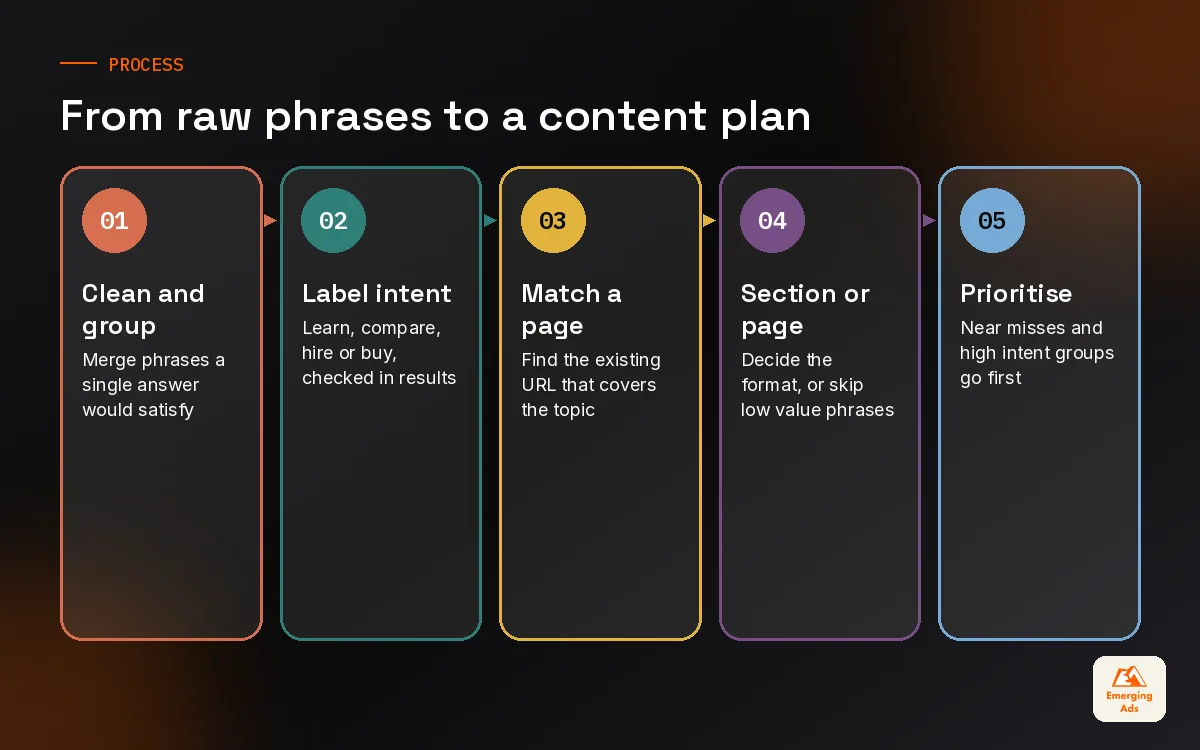
Group first, write second. One strong page that answers twenty related questions beats twenty weak pages that each answer one.
05Sections vs dedicated pages: the decision that makes or breaks it
This is where most long tail programmes go wrong. Someone exports a list of 300 phrases and briefs 300 articles. Six months later the site has hundreds of thin pages competing with each other and very little traffic to show for it. We make a deliberate choice for every group of long tail keywords.
Make it a section when
- The phrase is a sub-question of a topic an existing page already covers.
- The answer is a few paragraphs, a table or a short list, not a full guide.
- Google’s results for the phrase show broad guides that mention the answer, rather than pages dedicated to it.
Give it its own page when
- The intent is clearly different from anything on your site: a comparison, a specific use case, a location, a distinct audience.
- The ranking pages are dedicated to that exact question.
- There is enough to say to genuinely help someone, including examples, steps or data you actually have.
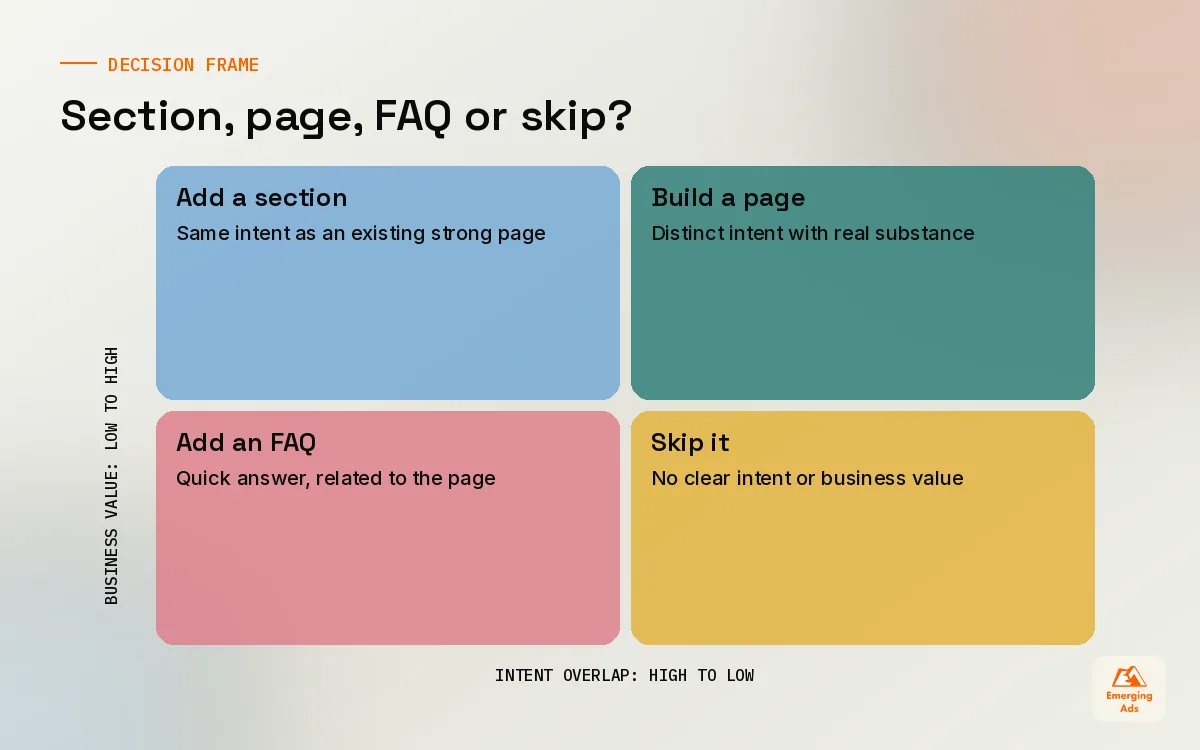
A home services client wanted separate pages for “boiler service cost”, “how much is a boiler service” and “boiler service price”. Same intent, same answer. We folded them into one pricing section on the boiler service page with a clear table and an FAQ. That page now ranks for all three variations and dozens more, instead of three pages splitting the signals. Our on-page SEO team handles exactly this kind of consolidation when it has already happened.
06Avoiding thin pages and cannibalisation
Thin content and keyword cannibalisation are two sides of the same mistake: treating every phrase as a page. Here is how we keep long tail work clean on the sites we manage.
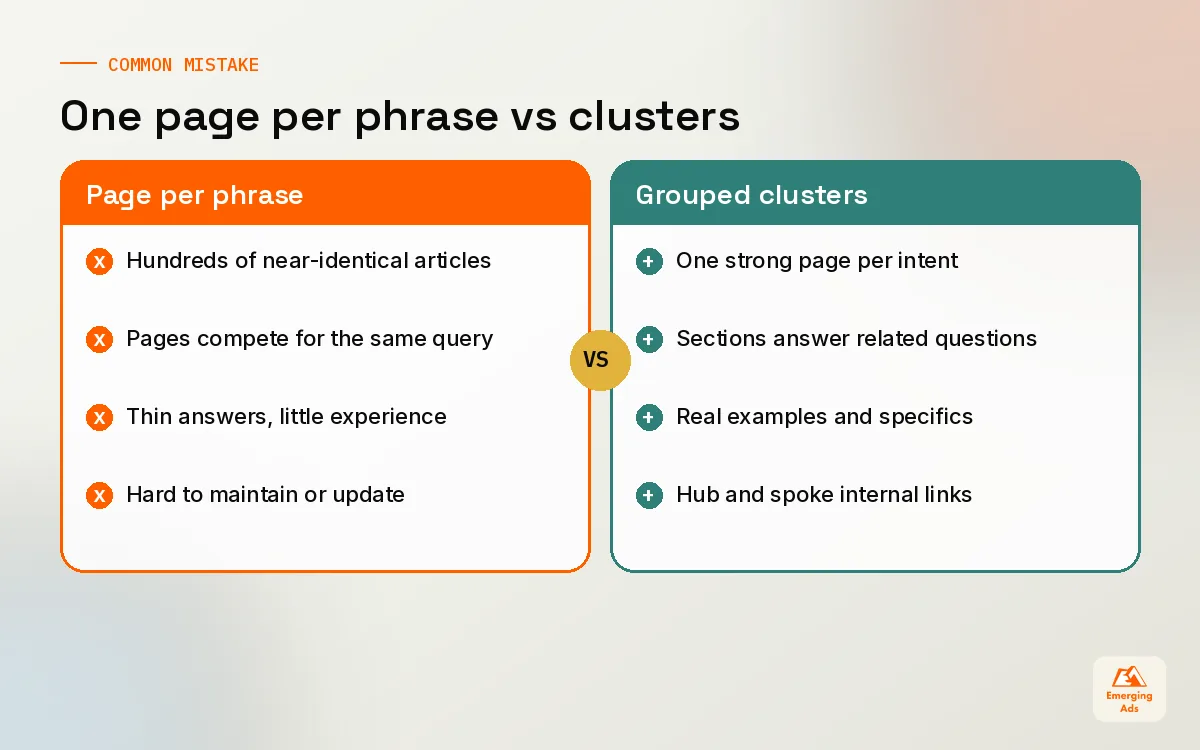
- One intent, one URL. Keep a simple keyword map with the primary intent for every page. Before briefing a new page, check the map.
- Search your own site first. A site: search for the phrase often reveals an old blog post or a tag page that already targets it.
- Watch Search Console for split rankings. If two URLs swap places for the same query week to week, they are competing. Merge the weaker one into the stronger and redirect it.
- Write with substance. A long tail page earns its place with something specific: a worked example, a comparison table, a photo of the real product, an answer from someone who does the job.
- Link sections and pages together. Link the new page from the hub page and back, using natural anchors. Internal links are how Google understands the cluster.
A useful habit is a quarterly pruning pass. Pull every page with low clicks and impressions over the past year. Improve the ones with a clear purpose, merge the ones that overlap, and remove or noindex the ones that never should have existed. Many sites we inherit see their long tail rankings improve after pruning, simply because the remaining pages are clearer.
07Writing long tail content that actually ranks
Long tail keywords reward a particular writing style. The searcher asked a specific question, so answer it early, then add the context and detail that make the answer trustworthy.
- Answer in the first two sentences of the section or page, in plain words. Then explain.
- Use the customer’s phrasing in a heading where it reads naturally. Do not force awkward exact matches.
- Show experience. Mention what you see with real customers, what usually goes wrong, what you would do.
- Structure for scanning. Tables for comparisons, numbered steps for processes, short FAQs for follow-up questions.
- Link to the next step. A long tail reader is close to acting, so link clearly to the relevant service or product page.
Tools like Surfer can help check that a draft covers the subtopics competing pages cover, but they cannot supply the experience. For clients who want the whole process run for them, from mining to mapping to briefs, our keyword research services and content strategy team work as one.
08Measuring long tail wins
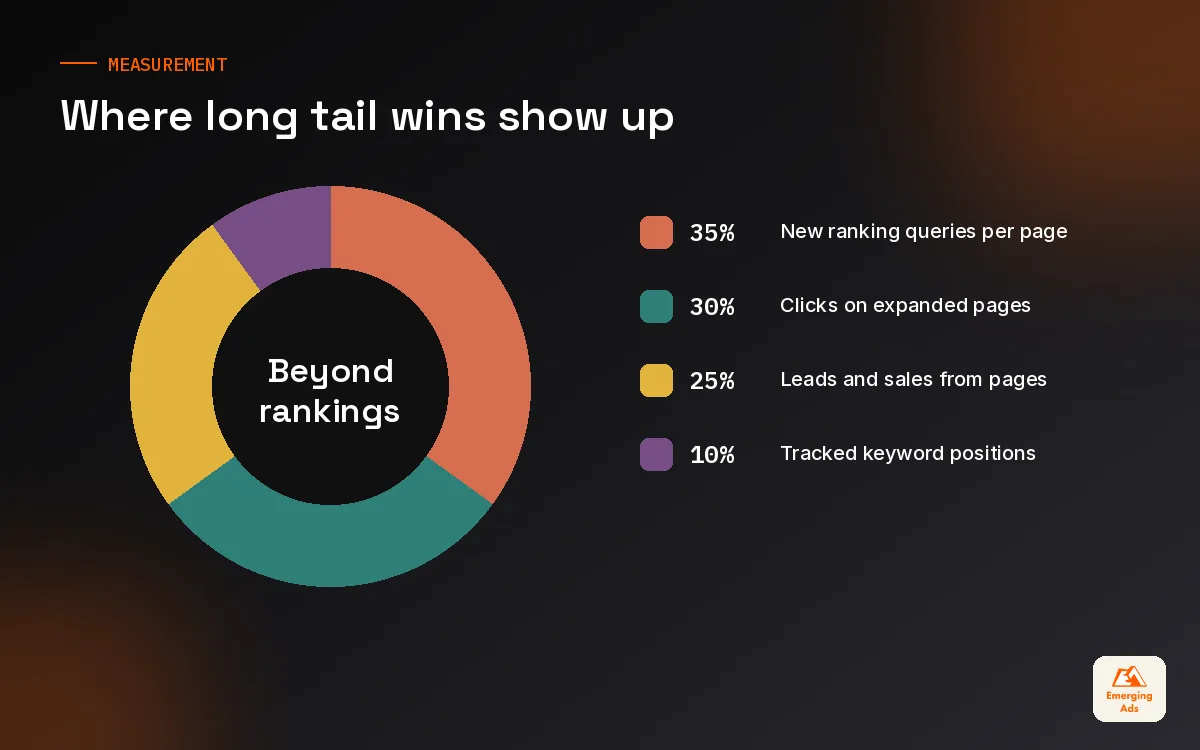
Long tail success does not show up well in a rank tracker. You might track twenty phrases, while the page ranks for four hundred you never thought of. We measure it differently.
| What to measure | Where | What good looks like |
|---|---|---|
| Queries per page | Search Console, Performance, filter by page | The count of ranking queries climbs month on month |
| Impressions and clicks | Search Console, compare periods | Clicks grow on the pages you expanded |
| Average position for the query group | Search Console, regex filter for the group | Near misses move from page two to page one |
| Leads or sales from those pages | GA4 landing page report with conversions | Enquiries or revenue tied to the pages you built |
Give it time. Sections added to an existing, indexed page often move within weeks. New pages on a newer site can take a few months to settle. We review long tail work quarterly, prune and expand, and feed the winners into the next round of research.
If you would like to read more on the building blocks, the usemergingads.com blog covers technical SEO, on-page work and link building in the same practical way. And if you want help turning your customer questions into traffic, our full list of services shows how we combine SEO, content and paid search.
Frequently asked questions
Straight answers to what clients ask us most about long tail keywords.
What are long tail keywords?
How many words is a long tail keyword?
Are long tail keywords good for new websites?
How do I find long tail keywords for free?
Should every long tail keyword get its own page?
What if a keyword tool shows zero search volume?
How long does it take to rank for long tail keywords?
What is keyword cannibalisation and how does long tail cause it?
Do long tail keywords help with AI search?
How do I track long tail keyword performance?
Can I use long tail keywords in Google Ads too?
Want a list of long tail keywords you could rank for this quarter?
We will mine your Search Console, competitors and customer questions, then hand you a prioritised list mapped to existing pages and new ones worth writing.
Book your free audit