Local SEO Explained Step by Step: What Actually Moves the Map Pack
Local SEO is the least glamorous corner of search and, for a plumber, a dental clinic or a ten-branch gym chain, the one that pays the bills. Here is the order we work in, what we skip, and how we prove it is working.
Key takeaways
- Local SEO starts and ends with your Google Business Profile: primary category, accurate details and steady fresh reviews.
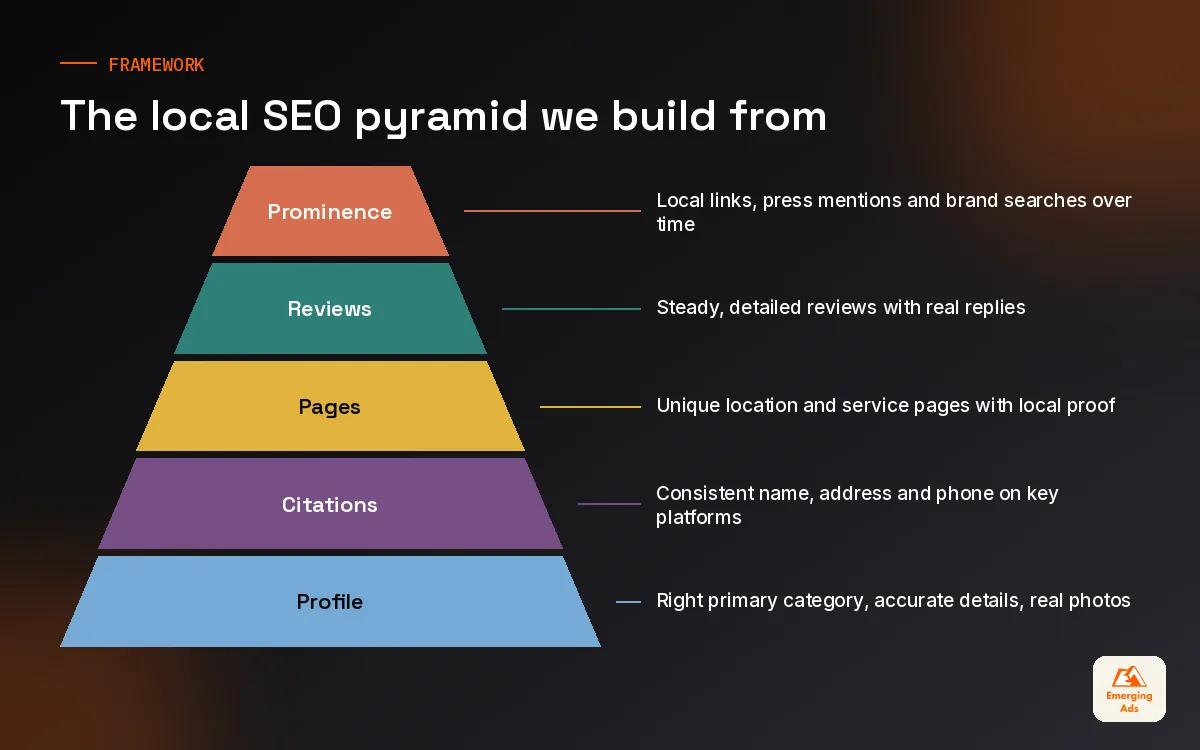
- Google has said local results weigh relevance, distance and prominence. You control the first, you cannot fake the second, and you earn the third.
- Location pages only work when each one is genuinely local: real staff, real jobs, real directions, not a swapped town name.
- Citations are hygiene, not a growth lever. Fix the big ones, stop paying for hundreds of tiny directories.
- Measure calls, direction requests and booked jobs by location, not just rankings from one postcode.
01What local SEO really is (and why it behaves differently)
Local SEO is the work of getting a business found by people searching for something nearby, usually in the Google map pack and the organic results just below it. It sounds like a smaller version of normal SEO. In practice it behaves like a different sport. A two-page website with a well-run profile can beat a national brand with a thousand pages, because the map pack cares about who is close, who is relevant and who people trust.
We run local search for clinics, trades, law firms, restaurants and multi-location brands, and the pattern repeats. Owners assume the problem is the website. Nine times out of ten the first win sits in the Google Business Profile, then in reviews, and only then in pages and links. This guide follows that order, because it is the order that pays back fastest.
Two results pages in one
A search like “emergency electrician Leeds” usually returns a map pack of three businesses and then ordinary blue links. They are ranked by different systems. The map pack leans heavily on your profile and proximity. The blue links behave more like classic SEO and reward strong location and service pages. Good local SEO plays both boards at once, and the local SEO work we do for clients always reports them separately so nobody confuses a map win with an organic one.
02Step 1: Get your Google Business Profile genuinely right
Most profiles we audit were set up in a hurry years ago by whoever had the login. Categories are vague, hours are wrong on bank holidays, the description reads like a brochure and the photos are three logos and a blurry van. None of that is fatal on its own. Together it tells Google, and every searcher, that nobody is minding the shop.
Categories do more work than anything else you can edit
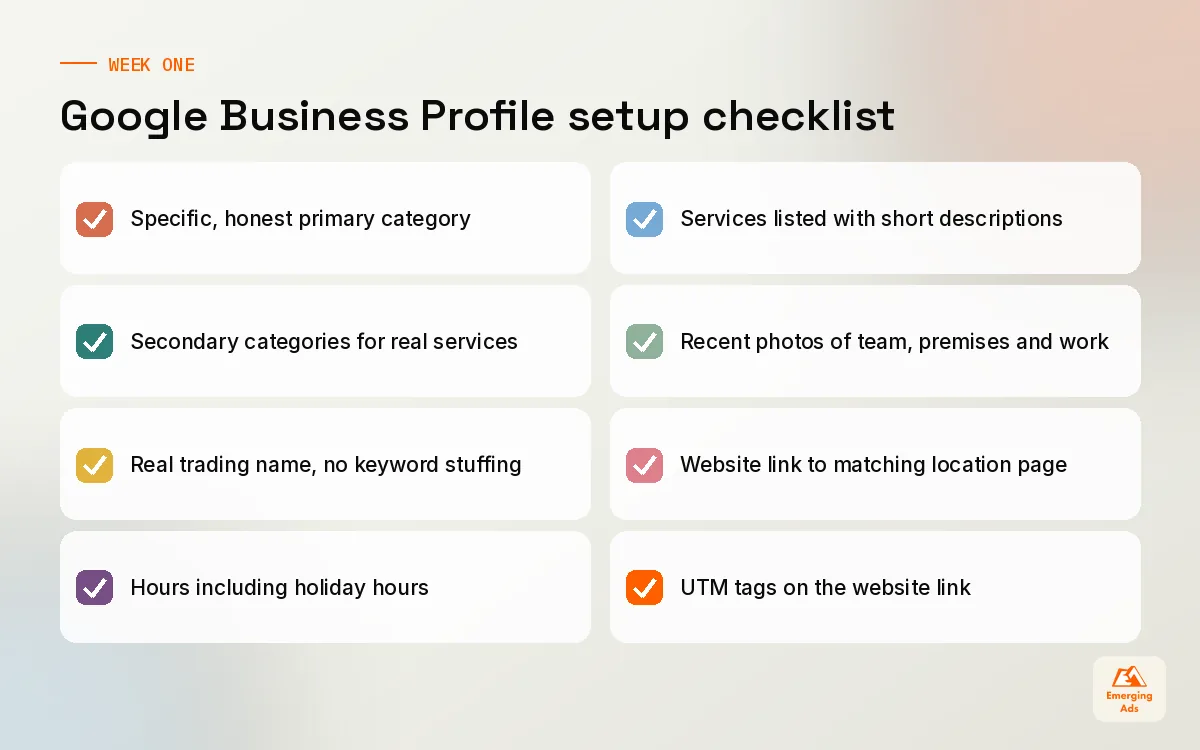
The primary category is the single strongest relevance setting on the profile. A family law firm listed as “Law firm” competes on a vague term. The same firm listed as “Family law attorney” or the local equivalent suddenly matches what people type. We pick the primary category by searching the main money term, noting the primary category of the top three results, and matching the most specific one that is honestly true. Secondary categories then cover real extra services, not wishful ones.
- Name: your real trading name. Stuffing “Best Dentist Manchester” into it can get a profile suspended, and competitors do report it.
- Address or service area: show the address if customers visit you. If you go to them, set a service area and hide the address.
- Hours: include holiday hours. Being shown as open when you are closed earns angry reviews.
- Services and products: list them with short plain descriptions. They help relevance and they help the searcher decide.
- Photos: real team, real premises, real work. Update them through the year, not once.
- Website link: point it at the matching location page, not always the homepage, and tag it with UTM parameters so you can see it in analytics.
Posts, Q and A, and messaging
Profile posts will not rescue a weak profile, but they help conversion. We use them for seasonal offers, new services and short proof points like a finished job. Seed your own questions and answers with the things your reception team hears every day: parking, prices from, whether you take walk-ins. If you switch on messaging, someone must answer within the day. A slow reply is worse than no button.
03Step 2: Build a review engine, not a review campaign
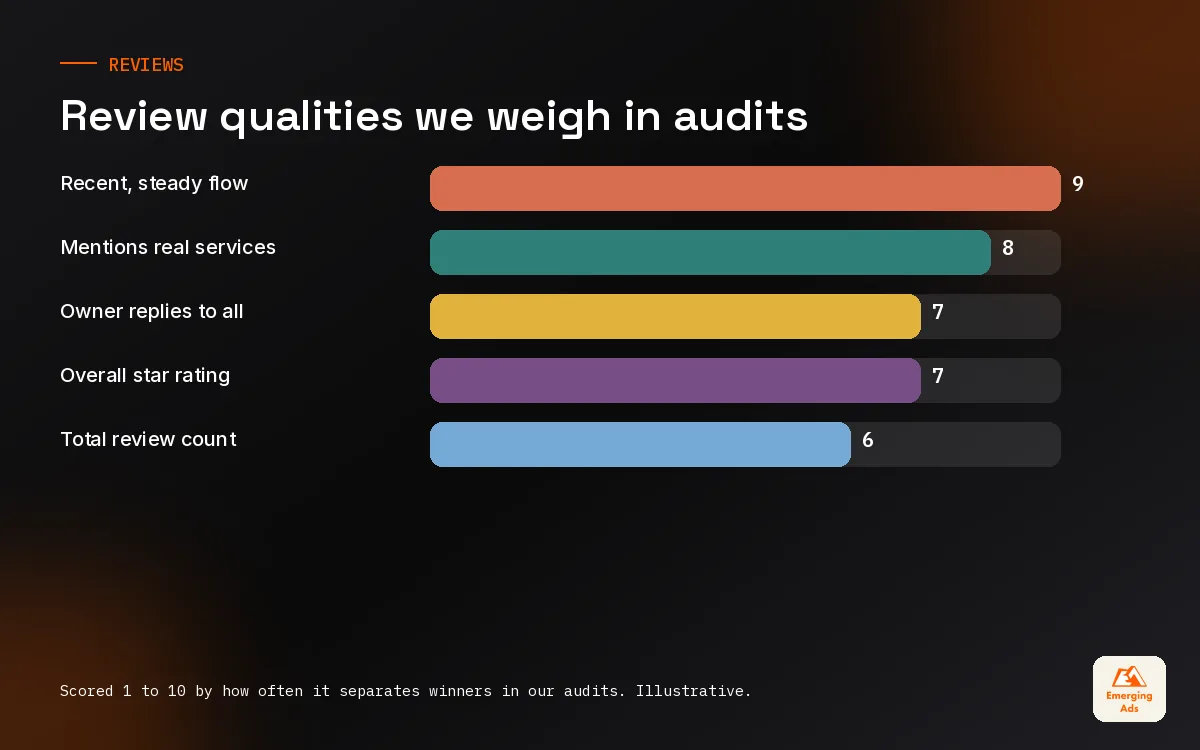
Reviews are the part of local SEO owners feel most personally, and the part most often handled badly. A burst of forty reviews in one week after a staff push, then silence for six months, looks exactly like what it is. What we see working on the accounts we manage is steady flow: a few new reviews every week, mentioning real services, with replies from a real person.
How to ask without being awkward
- Ask at the moment of relief: the boiler is fixed, the implant is healed, the keys are handed over.
- Send a short link by text or email the same day. Every extra tap loses people.
- Ask for detail gently: “If you mention what we helped with, it really helps others find us.”
- Reply to every review, good or bad, within a couple of days, in your own words.
- Never offer money, discounts or gifts in exchange for reviews, and never filter out unhappy customers before asking. Both break Google’s rules.
A physiotherapy clinic we work with moved the review request from a monthly email blast to a text sent by the therapist at the end of the final session. Nothing else changed. The flow of reviews became steady and, more usefully, the reviews started naming conditions and treatments, which is exactly the language new patients search with. For clinics, the rules around patient privacy matter too, which is why our healthcare marketing team writes reply templates that never confirm someone was a patient.
04Step 3: NAP consistency and citations, without the busywork
NAP means name, address and phone number. Citations are the places those details appear across the web: directories, maps apps, industry listings, chambers of commerce. Consistency matters because conflicting data makes Google less sure which details are true. That said, citations are hygiene. Fixing them stops a leak. Adding hundreds more rarely grows anything.
| Citation type | Examples | Our priority |
|---|---|---|
| Core data platforms | Google, Apple Maps, Bing Places, Facebook | Fix first, check quarterly |
| Big general directories | Yelp, Yell, Yellow Pages style sites for your country | Claim and correct |
| Industry directories | Trade bodies, legal and medical registers, wedding sites | High value, often send real leads |
| Local sources | Council listings, chamber of commerce, local news business pages | Worth the effort, often also a link |
| Bulk low-quality directories | Auto-generated listing farms | Ignore, do not pay for these |
The mess usually comes from history: an old phone number from before the move, a previous address, a tracking number someone used for a print campaign. We export every listing we can find, sort by which details are wrong, and fix the most visible ones first. When a business moves, this job moves to the top of the list, because the old address can keep appearing for months.
05Step 4: Location pages that deserve to rank
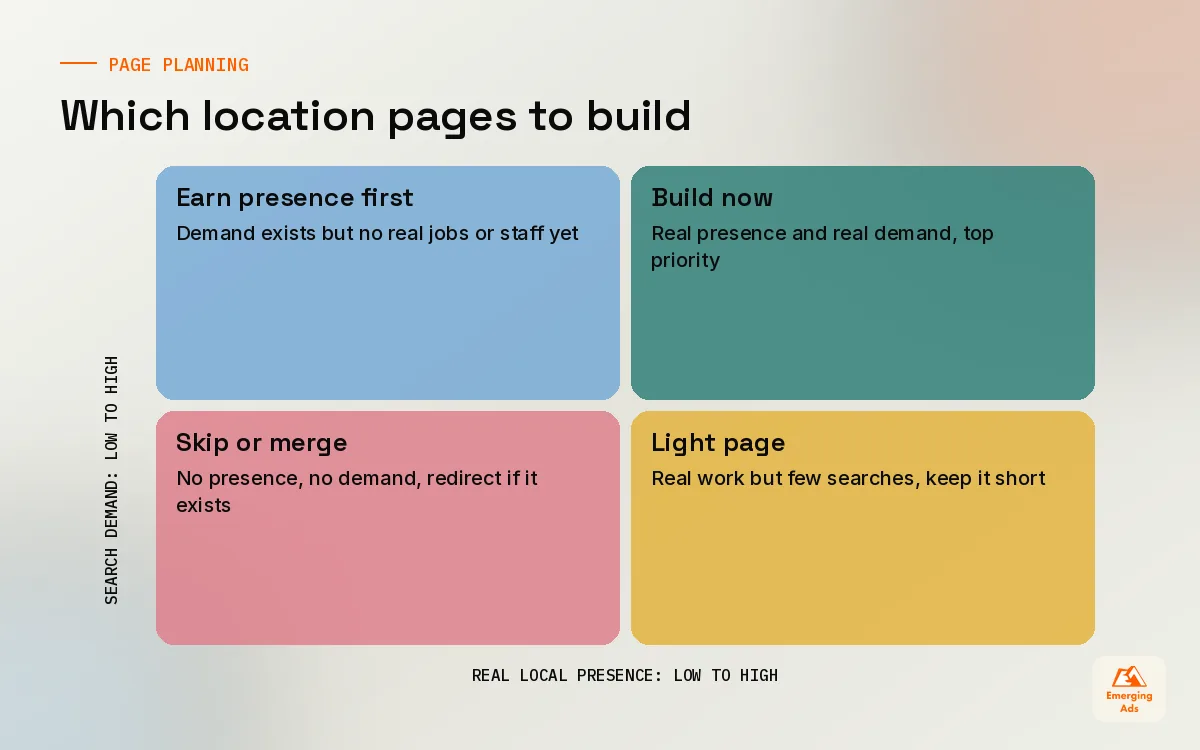
Here is where local SEO meets the website. Each location or core service area needs one page that answers everything a local searcher wants, and says it in a way only you could say it. The lazy version, a template with the town name swapped fifty times, used to work for a while. On the sites we inherit it now mostly sits unindexed or ranks nowhere, and it drags down trust in the rest of the site.
What goes on a good location page
- The exact NAP matching the profile, with an embedded map and simple directions from landmarks people know.
- Opening hours, parking, access information and what to expect on a first visit.
- The team at that branch, with names, photos and a line about each person.
- Services offered at that location, linking to the main service pages.
- Local proof: reviews from that branch, photos of real jobs nearby, case notes from the area.
- A clear call to action above the fold, with a click-to-call button on mobile.
A roofing company we took on had forty-two town pages with identical text. We cut them to nine towns where they had real crews and real jobs, rewrote each one around recent projects in that town, and redirected the rest to the nearest real page. Fewer pages, far better results in the towns that mattered. If your site makes this kind of work painful, a cleaner WordPress build or a set of purpose-built local landing pages is often cheaper than fighting an old theme.
Service pages still matter alongside location pages, and the on-page basics from our on-page SEO guide apply here too: one clear topic per page, titles that match intent, headings that make sense on their own. Crawlability matters as much as copy, and if location pages are orphaned or blocked, the technical SEO field guide covers how we find and fix that.
06Step 5: Local links and mentions that build prominence
Prominence is the slow part of local SEO. It is built from reviews, links, mentions and general reputation, and you cannot fast-track it without taking risks. The good news is that local links are often easier to earn than national ones, because the relationships already exist. You just have not asked.
| Local link source | How we usually earn it | Effort |
|---|---|---|
| Suppliers and trade partners | Ask to be listed on their stockist or installer page | Low |
| Sponsorships | Junior sports clubs, charity runs, school events | Low to medium |
| Local news | Genuine stories: a new branch, an apprenticeship scheme, a useful local survey | Medium |
| Community resources | A practical local guide, such as a parking map for your area | Medium |
| Professional bodies | Member directories and speaker pages | Low |
A family-run veterinary practice we support gets more value from a single link on their local council’s pet services page than from any directory. The broader tactics, including outreach and what to avoid, are in our link building guide, and when a business needs a steady programme rather than one-off wins, our link building services handle it with the local angle built in.
The businesses that win locally are the ones people already talk about. Our job is to make sure Google hears the conversation.
07Service area businesses and multi-location brands
Service area businesses
If you visit customers rather than the other way round, set a service area on your profile and hide the street address. Be realistic about the area. Listing every town in the county does not make you appear in all of them, because distance from your verified location still matters. We usually build pages for the handful of areas where the business genuinely has work and reviews, and let the rest come from strong service pages.
Multi-location brands
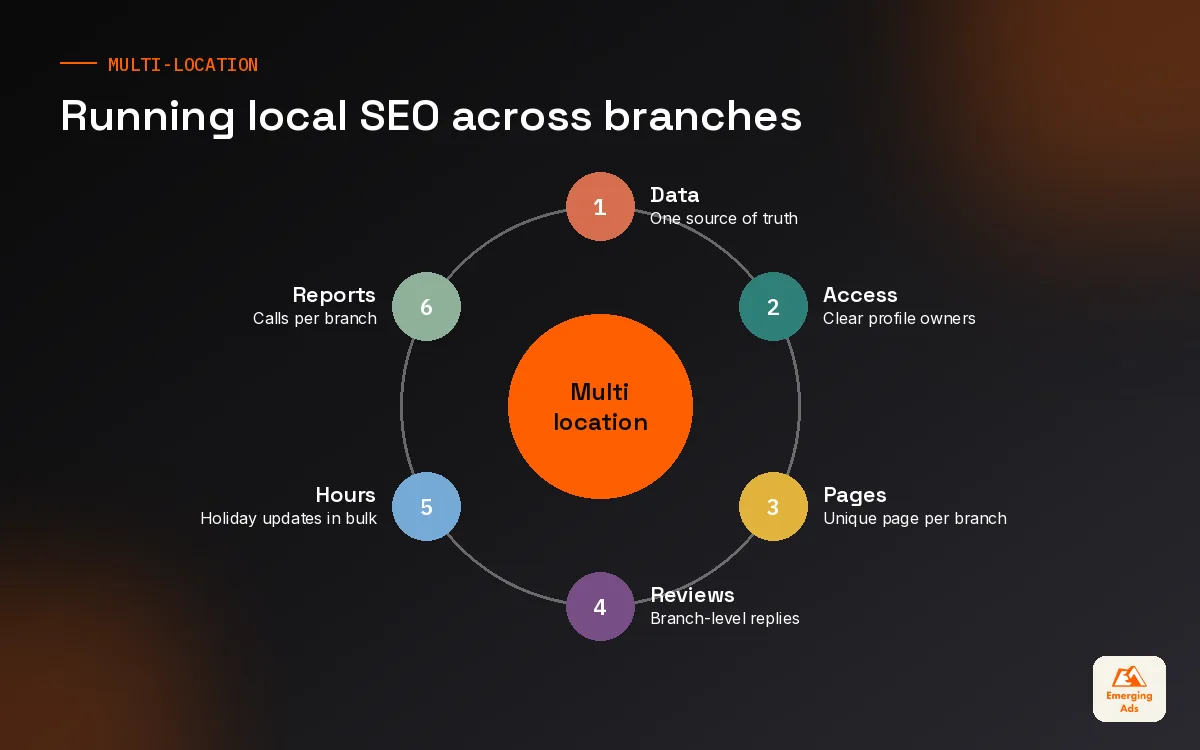
With ten or fifty branches the problems change. It is less about a single profile and more about control: who owns the logins, how hours are updated for a bank holiday across every branch, whether a branch manager can reply to reviews, and how the location pages stay in sync with the profiles. We set up one source of truth for location data, bulk verification where possible, and a simple monthly report per branch.
| Question | Single location | Multi-location |
|---|---|---|
| Who owns the profile | Owner or marketing lead | Central team with branch managers as managers |
| Location pages | One strong page plus service pages | One unique page per branch, built on a shared template |
| Reviews | Owner replies personally | Reply guidelines plus branch-level replies |
| Reporting | Calls, directions, bookings | Same, per branch, ranked against each other |
For owner-led businesses, local search is usually one piece of a wider plan with ads, email and a website that converts, which is why we often start with our local business marketing services and fold SEO into them. If you are comparing agencies, our write-up on choosing a local marketing agency covers the questions worth asking.
08Tracking local SEO: calls, directions and booked jobs
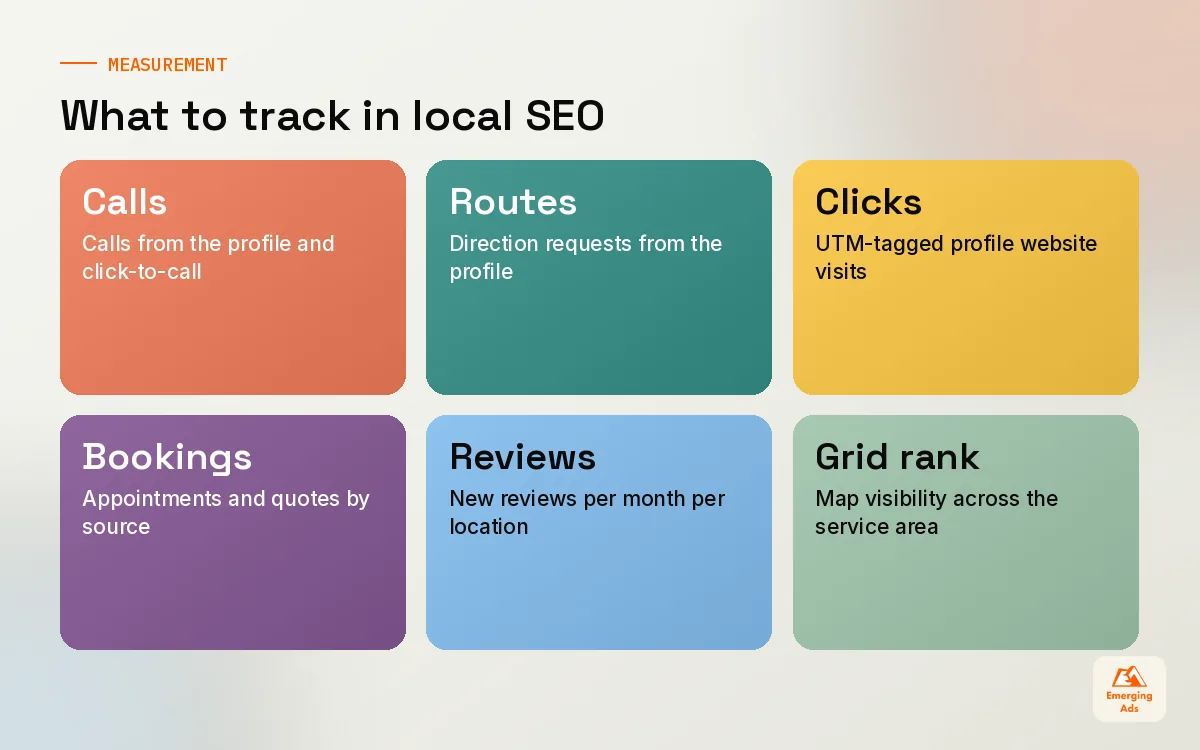
Rankings from one postcode tell you very little, because the map pack shifts street by street. We track three layers. First, profile actions from Google Business Profile performance data: calls, direction requests and website clicks. Second, website behaviour from UTM-tagged profile clicks in GA4. Third, real outcomes: booked appointments, quote requests and sales, matched back to the source wherever the booking system allows.
- Tag the profile website link with UTM parameters so profile traffic stops hiding inside “organic”.
- Track click-to-call and form submits as key events, set up properly through Google Tag Manager.
- Use a grid-based rank tracker for a realistic view of map visibility across your area.
- Pull it together per location in a Looker Studio dashboard so branch managers can see their own numbers.
The piece most businesses are missing is the analytics foundation. If your GA4 property still counts every page view as a conversion, a clean GA4 setup comes before any clever reporting. You can see the full range of what we offer on our services page.
09A simple 90-day local SEO plan
| Weeks | Focus | Output |
|---|---|---|
| 1 to 2 | Audit profile, categories, NAP and tracking | Fix list and baseline report |
| 3 to 4 | Profile rebuild, photos, services, UTM tags | A complete, accurate profile |
| 5 to 8 | Review system, citation clean-up, location pages | Steady reviews and one strong page per location |
| 9 to 12 | Local links, posts, first results review | Links earned and a plan for the next quarter |
That is the whole method, and it is deliberately unexciting. Local SEO rewards businesses that do the basics properly and keep doing them. If you want more guides like this, the usemergingads.com homepage lists everything we publish, and our clinic-focused piece on medical practice SEO goes deeper on regulated sectors.
Frequently asked questions
Straight answers to what clients ask us most about local seo.
What is local SEO in simple terms?
How long does local SEO take to work?
What is the most important local ranking factor?
Do I need a website for local SEO?
How many reviews do I need to rank locally?
Should I create a page for every town I serve?
What are citations and do they still matter?
Can a service area business rank without showing an address?
How do I track results from my Google Business Profile?
Is local SEO different for multi-location businesses?
Can I use a call tracking number on my profile?
Should I hire an agency or do local SEO myself?
Losing the map pack to a competitor with fewer reviews?
Send us your business name and main town. We will check your profile, categories, citations and location pages, then tell you plainly what is holding you back.
Book your free audit