The Practical Link Building Guide We Hand to New Clients
Link building has a reputation problem, mostly earned by people selling shortcuts. This is the version we walk new clients through: what earns links now, how we run outreach without spamming anyone, and how to tell a good link from an expensive mistake.
Key takeaways
- Link building works best when there is something on your site genuinely worth linking to.
- Digital PR, useful assets and relationships earn the links that last; bought links tend to disappear or cause trouble.
- Broken link, resource page and unlinked mention outreach are slow but reliable wins for most sites.
- Judge a link by relevance, real traffic and editorial context before you look at any authority score.
- A steady, modest cadence of outreach beats a burst of activity followed by silence.
01What link building actually means in 2026
Link building is the work of getting other websites to link to yours. Links remain one of the main ways search engines judge whether a page deserves trust, and they send referral visitors of their own. What has changed over the fifteen years we have been doing this is how links are earned. Tricks that worked in 2012 are either ignored now or actively risky. What still works looks a lot more like public relations and partnership building than the spreadsheets of “guest post opportunities” people still get sold.
When a new client asks us how many links they need, we answer with a question: how many do the pages outranking you have, and where did they come from? For a local accountant, a handful of solid links from the local chamber of commerce, a professional body and a couple of business publications can be enough to compete. For a SaaS company going after competitive comparison terms, it is a much longer programme. The number is less important than the gap, and the gap is measurable.
Why links still matter
Search engines use links to discover pages and to understand how the web vouches for them. A link from a respected site in your industry is a vote that is hard to fake. Links are not everything, and a site with perfect on-page work and modest links will often beat a site with lots of links and a poor page. That is why we always fix the page before we build links to it. If you have not already, read our on-page SEO field guide first. Sending links to a page that does not satisfy intent is money down the drain.
02What earns links now (and what does not)
The link building strategies that keep working for our clients share one thing: the link exists because it helps the linking site’s readers. Everything else is a variation on that idea.
| Approach | Why it works | Effort | Risk |
|---|---|---|---|
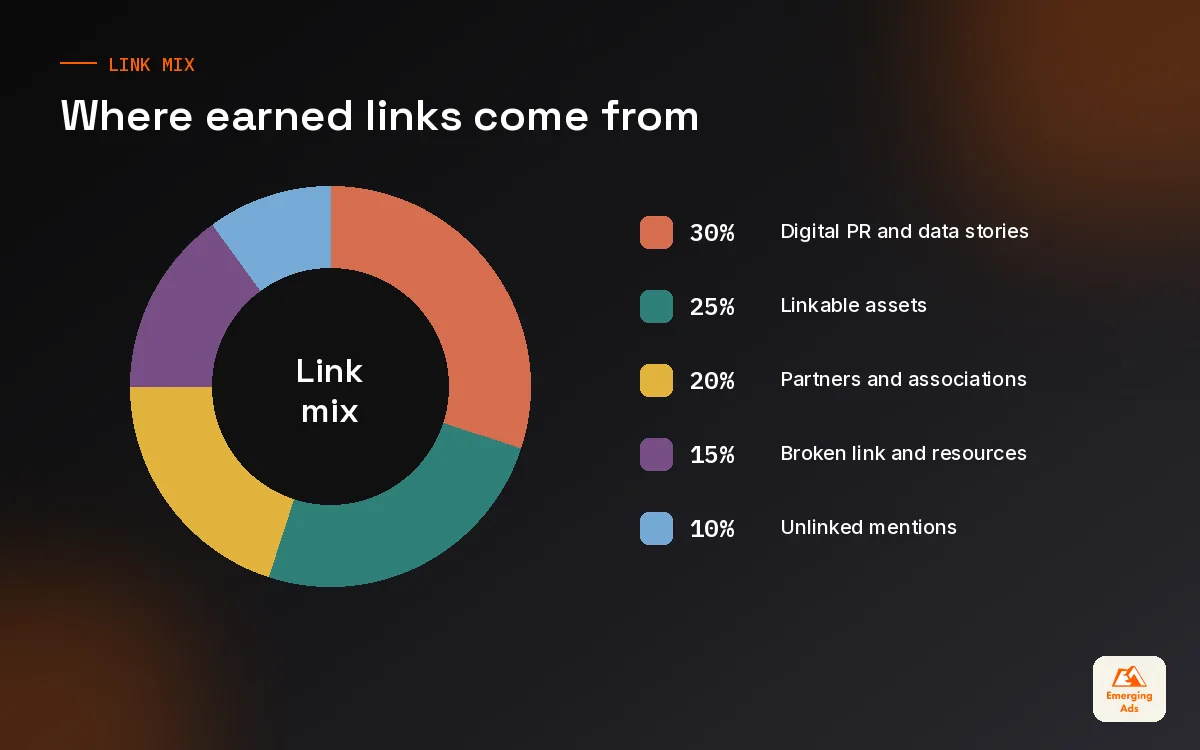
| Digital PR with original data or stories | Journalists need fresh angles and sources | High | Low |
| Linkable assets (tools, guides, templates) | People cite useful resources for years | Medium to high | Low |
| Broken link and resource page outreach | You fix a problem for the site owner | Medium | Low |
| Unlinked brand mentions | They already talked about you | Low | Low |
| Partnerships, suppliers, associations | Real relationships, relevant sites | Low to medium | Low |
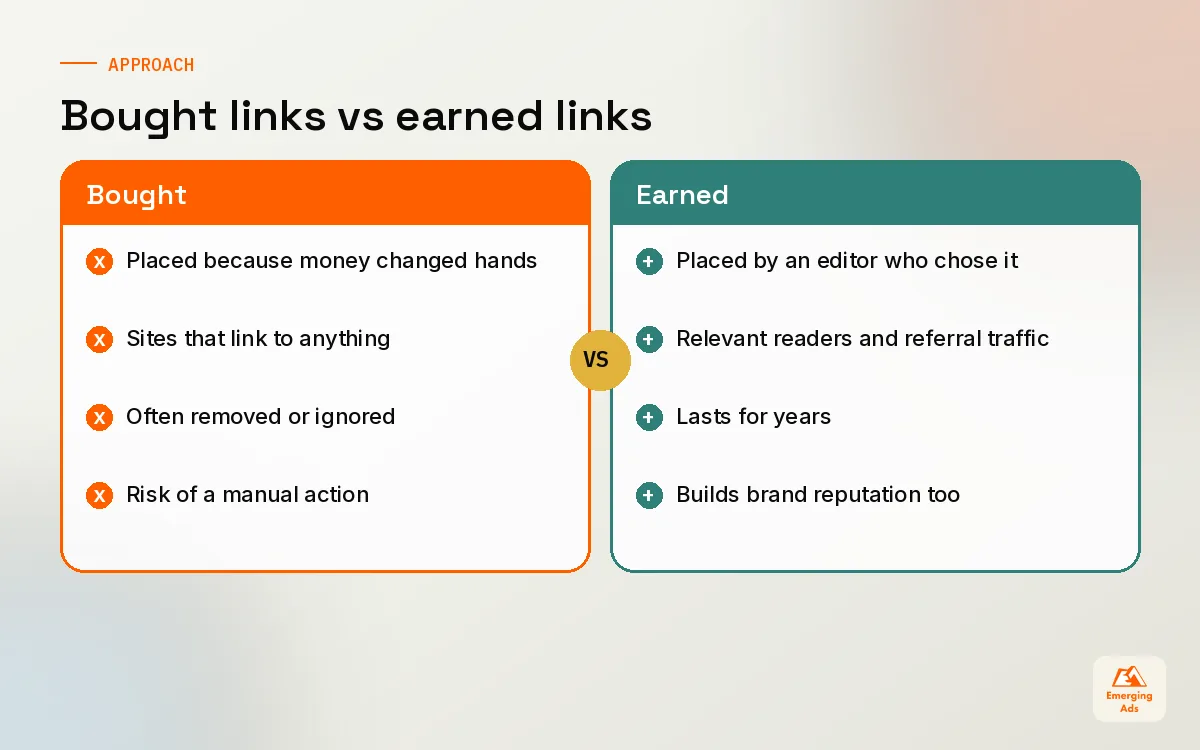
| Paid links, PBNs, link exchanges at scale | Short-term signal, if any | Low | High |
Notice that the low-risk approaches all take effort. That is the point. If a link can be bought in bulk by anyone with a credit card, it cannot be a strong signal of trust, and search engines know it. Our link building services are built around the top five rows of that table and never the last one.
03Digital PR: giving journalists something they need
Digital PR is the approach behind most of the strongest links we have earned for clients. The idea is simple: create a story, a piece of data or an expert comment that journalists want to cover, and pitch it to them. When it lands, you get coverage on sites that would never accept a guest post.
Three digital PR formats that work for ordinary businesses
- Data from your own business. An ecommerce client selling garden products looked at which plants sold out first during a heatwave. That became a short, useful story for gardening and home sections. Anonymised internal data is the most underrated PR asset most companies own.
- Surveys with a clear angle. A small survey of your customers or a panel can work, provided the question is interesting and the method is honest. Publish the method alongside the results.
- Expert commentary. Journalists use platforms and social posts to request expert quotes. A B2B client’s finance director became a regular source on a niche tax topic simply by answering those requests quickly and clearly.
The pitch matters as much as the story. Keep it short, put the headline finding in the first line, offer the data or an expert for interview, and send it to journalists who actually cover that topic. A generic pitch to a list of five hundred addresses does more harm to your reputation than good.
Journalists do not owe you a link. Give them a story they would be annoyed to miss.
Strong brand positioning makes PR much easier. When a company knows exactly what it stands for, the stories write themselves. That is one reason our branding and content team often sits in on PR planning.
04Linkable assets: build something worth citing
A linkable asset is a page designed to be referenced. It keeps earning links long after it is published because people find it while researching and cite it in their own work. The best ones answer a question that people in your industry ask again and again.
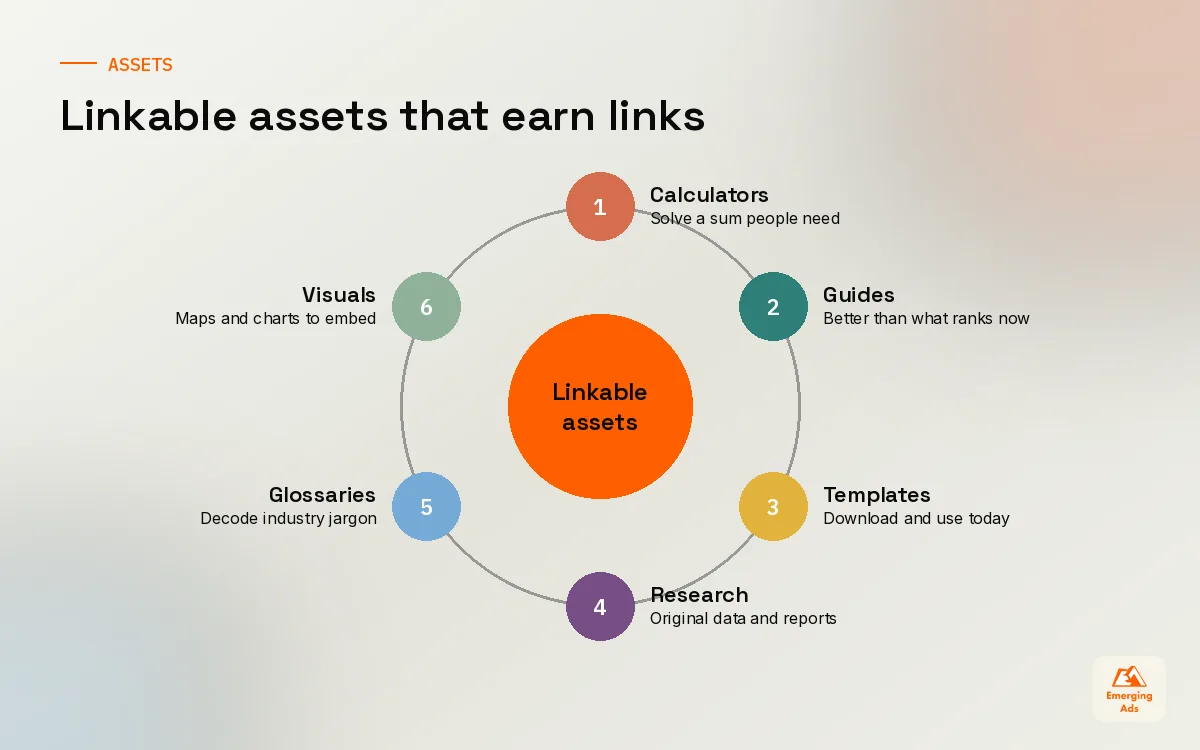
Asset types we have seen earn links
- Calculators and simple tools. A mortgage overpayment calculator, a shipping cost estimator, a paint quantity calculator.
- Definitive guides that are clearly better than anything else on the topic, with original diagrams.
- Templates and checklists people can download and use straight away.
- Glossaries for industries full of jargon.
- Original research and annual reports built on your own data.
- Visual explainers such as maps, charts and process diagrams that others want to embed.
For an industrial supplier, we built a simple materials comparison chart that engineers could use to choose between options. It was not glamorous. It did earn links from university course pages, trade forums and supplier directories, because it solved a real problem for people who write about that subject. Good asset ideas usually come from keyword research and from the questions your sales team hears every week. Our content strategy work turns those into a plan.
05Outreach that does not feel like spam
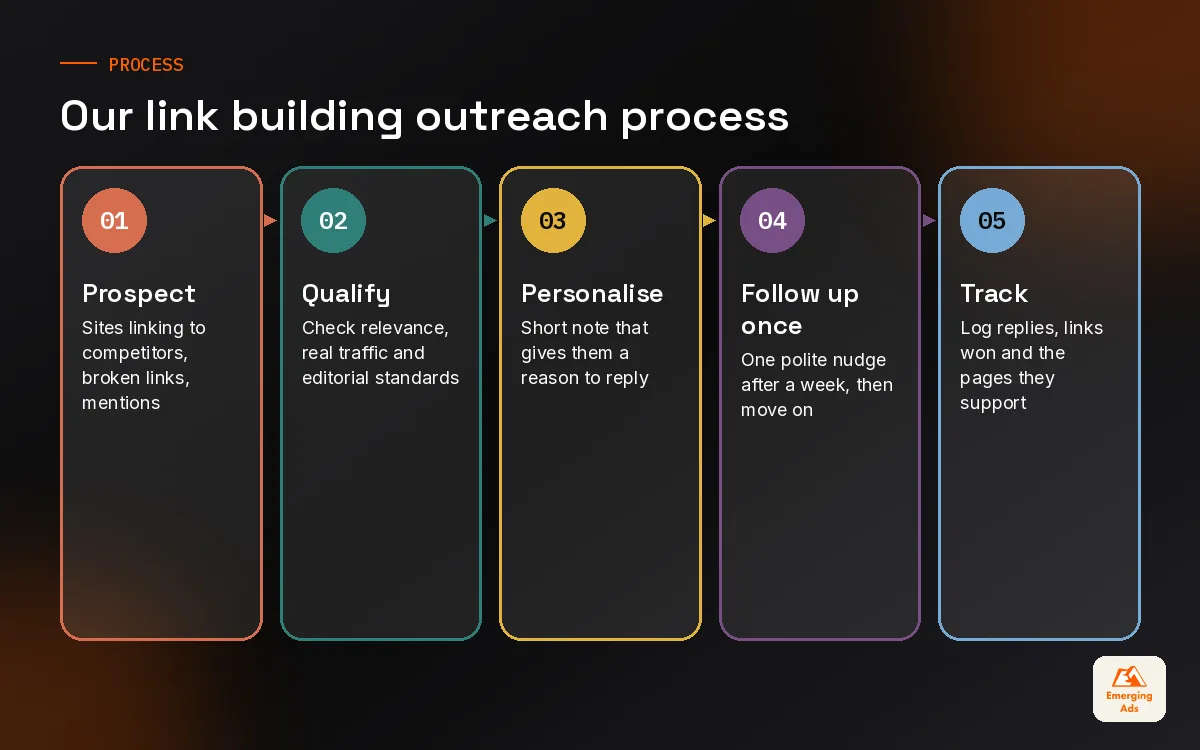
Outreach is where most link building goes wrong. People send templated emails to hundreds of sites, get ignored, and conclude that link building does not work. The three tactics below work because each one gives the site owner a genuine reason to reply.
Broken link outreach
Find pages in your niche that link to resources which no longer exist. Tools such as Ahrefs show you broken outbound links on relevant sites. If you have, or can create, a page that replaces the dead resource, email the site owner, point out the broken link, and suggest yours as a replacement. You are doing them a favour first.
Resource page outreach
Many sites keep lists of useful resources: universities, councils, industry associations, hobby communities. If your page genuinely belongs on one of those lists, a short, polite note explaining why is often all it takes. The key word is genuinely. A plumbing company does not belong on a university’s research resources page, but it may well belong on a local council’s list of approved tradespeople.
Unlinked brand mentions
Once a business has any profile at all, people mention it without linking. Set up alerts for your brand and product names, check mentions every month, and ask politely for a link where it would help the reader. These are the easiest links you will ever earn because the site owner already likes you enough to write about you.
| Tactic | What to send | What to avoid |
|---|---|---|
| Broken link | The exact broken URL, where it is, and your replacement | Asking for a link without mentioning the fix |
| Resource page | One line on why your page helps their readers | Pitching pages that do not fit the list |
| Unlinked mention | Thanks for the mention, and a link suggestion | Demanding a link or being pushy |
| Digital PR | Headline finding, data, expert availability | Mass emails to journalists off-topic |
Competitor research makes outreach far more targeted. We use Semrush to see which sites link to two or three of your competitors but not to you. That list is usually the best prospect list you can build, because those sites have already shown they link to businesses like yours.
06Partnerships and relationships: the links you already deserve
Before any cold outreach, we list every organisation a client already has a relationship with. It is surprising how many good links are sitting there unclaimed.
- Suppliers and manufacturers that list stockists or partners.
- Trade associations and professional bodies with member directories.
- Local organisations: chambers of commerce, business improvement districts, sports clubs and charities you support.
- Customers who publish case studies or testimonials about their suppliers.
- Events you speak at, sponsor or host.
- Software and integration partners, especially for SaaS businesses with listings in app marketplaces.
For local businesses, these relationships make up most of a healthy link profile. A dental clinic we work with earned links from the local running club it sponsors, a nearby school it gives talks at, and a regional health directory. None of those needed an outreach campaign, just someone asking. This sort of community link building sits naturally alongside our local SEO services.
07What to avoid: the link building that costs you later
Google’s spam policies are clear that buying or selling links that pass ranking credit, excessive link exchanges and large-scale guest posting with keyword-rich anchors count as link spam. We see the fallout regularly: businesses that bought packages of links, saw a short lift, then watched rankings slide and spent months cleaning up.
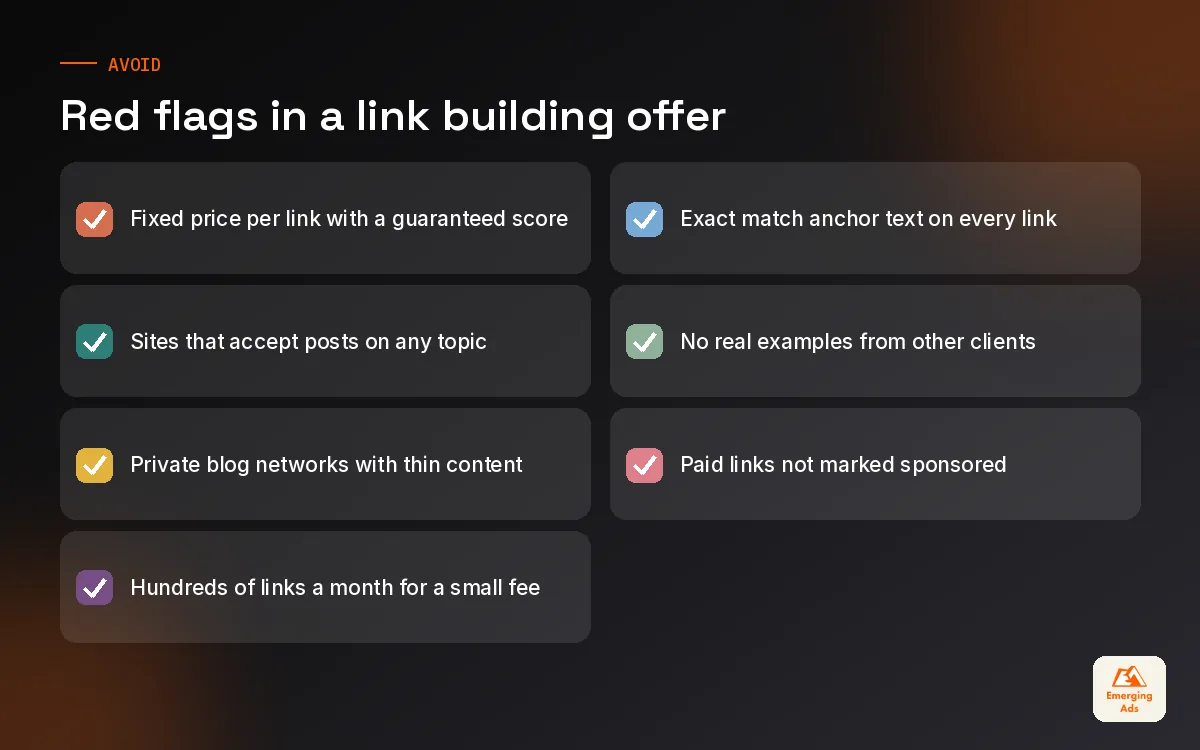
Red flags in a link building offer
- A fixed price per link with a guaranteed authority score.
- A list of sites that accept posts on any topic, from crypto to cookery.
- Private blog networks: sites that exist only to link out, often with thin, spun content.
- Promises of hundreds of links a month for a small budget.
- Exact match anchor text on every link.
- No willingness to show you examples of links built for other clients.
Sponsored content is not banned. If you pay for placement, the link should carry a rel=”sponsored” or rel=”nofollow” attribute, and then it is simply advertising. Where we see trouble is when paid links are dressed up as editorial ones.
If you inherit a messy link profile, do not panic. Google says it tries to ignore most spammy links rather than punishing you for them. We review the profile, remove what we reasonably can, and only use the disavow tool in Google Search Console when there is a clear pattern of manipulative links or a manual action to address.
08Measuring link quality and keeping a steady cadence
Third-party authority scores are useful for sorting a long prospect list. They are not how we judge a link. A link from a small, highly relevant trade blog with real readers can do more for a specialist B2B page than a link from a huge general site that links to everything.
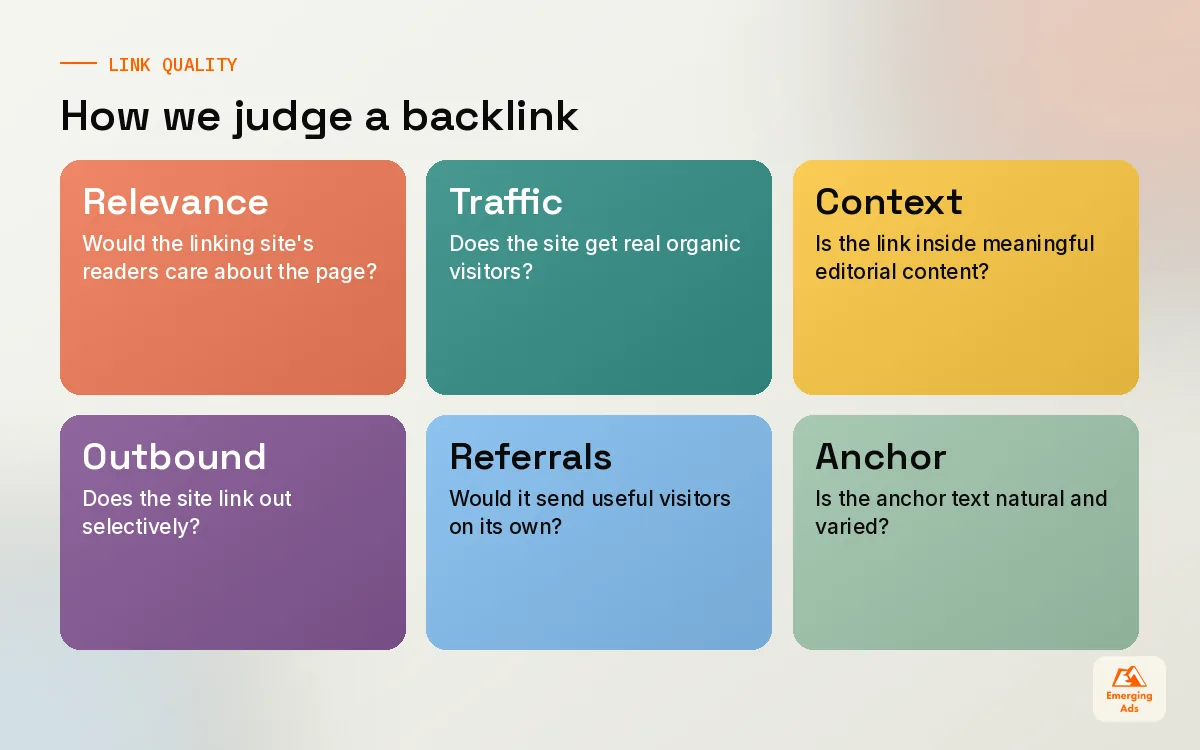
How we judge a link
- Relevance. Would the linking site’s readers genuinely care about the page?
- Real traffic. Does the site appear to get organic visitors, not just have a score?
- Editorial context. Is the link inside meaningful content, placed by a person who chose it?
- Outbound link pattern. Does the site link out selectively, or to anyone who asks?
- Referral value. Would you be pleased with this link even if search engines did not exist?
An outreach cadence that holds up
Link building rewards consistency. We would rather run a modest, steady programme every month than a big burst followed by silence. A typical rhythm on our accounts: one bigger asset or PR campaign a quarter, broken link and resource outreach every week, a monthly sweep for unlinked mentions, and partner outreach whenever a new relationship starts. Report on links earned, the pages they point to, referral traffic and ranking movement on those target pages, not just a count.
If you want to see what a well-run programme looks like in practice, our client success stories show the kind of results steady authority building supports, and the full list of our services shows how links fit alongside technical and content work. For more guides from our team, head back to the usemergingads.com homepage, or let our SEO specialists take the whole thing off your plate.
Frequently asked questions
Straight answers to what clients ask us most about link building.
What is link building?
How many backlinks do I need to rank?
Is link building still worth it in 2026?
Is it safe to buy backlinks?
What is digital PR in SEO?
How long does link building take to work?
Are guest posts still a good link building tactic?
Do nofollow links help SEO?
How do I find link building opportunities?
What makes a backlink high quality?
Should I use the disavow tool?
Not sure whether your backlinks are helping or hurting?
We will review your link profile against the competitors outranking you and show you where the gap really is, and which links are worth chasing first.
Book your free audit